

Wednesday, July 1, 2026: GPU and AI architecture startup OXMIQ Labs has raised $35 million in a Series A funding round, taking its total funding to $60 million.
The fresh capital will be used to scale OxCore, OXMIQ’s GPU architecture that semiconductor companies can license to build their own AI chips instead of designing an entire chip from scratch.
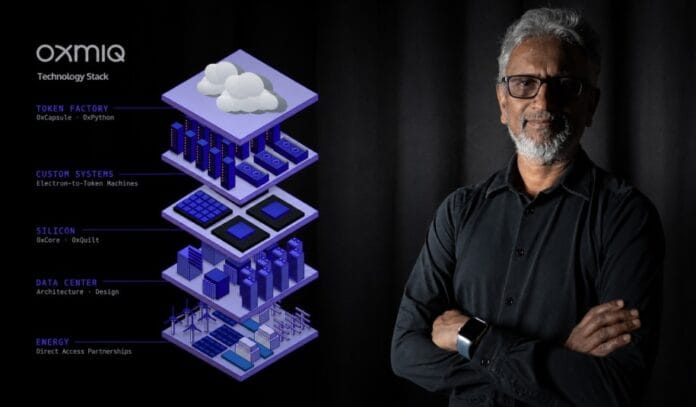
Founded by Raja Koduri, OXMIQ Labs is re-architecting the GPU stack from atoms to agents. The company delivers licensable GPU IP, modular chiplet platforms, and a complete software stack that enables semiconductor companies and AI infrastructure builders to own their compute without vendor lock-in.
The problem OXMIQ is solving
As AI models become larger and more widely used, demand for AI computing power is growing much faster than the infrastructure available to support it.
Today, building custom AI chips is expensive, time-consuming and largely limited to a handful of large companies with deep engineering resources.
OXMIQ wants to change that by offering reusable GPU technology that companies can license, customise and integrate into their own AI hardware, reducing both development costs and time to market.
The company says its architecture also gives customers more flexibility by allowing them to choose different manufacturing processes, memory technologies and packaging options instead of being locked into a single ecosystem.
OXMIQ to help companies build AI chips without starting from scratch
Beyond its GPU architecture, the GPU and AI architecture startup is also developing software that allows developers to run existing AI applications on its hardware without rewriting their code.
The company follows an IP licensing model rather than building complete chips itself, allowing it to generate revenue through licensing while keeping capital requirements lower than traditional semiconductor companies.
Industry veterans join the company
As part of its next phase of growth, the tech startup has expanded its leadership team.
Chip industry veteran Jim Keller, CEO of Tenstorrent, has joined the company’s board, while former Intel Fellow Dr. Valluri (Bob) Rao has joined as an advisor.
What investors said
David (Dede) Goldschmidt, SVP & Managing Director and Head of Samsung Catalyst Fund, said:
“We are very excited to co-lead OXMIQ’s financing round and back Raja Koduri and the strong team at OXMIQ. OXMIQ’s novel AI core and software platform enable heterogeneous compute for efficient, custom inference solutions serving large-scale agentic workloads.”
Rajeev Surati, Partner at Fundomo, added:
“Raja has built silicon at every layer of the stack, and he knows exactly where the constraints sit. Most compute IP makes the customer bend their memory, packaging, and foundry around the chip. OXMIQ does the opposite, and that flips a cost center into leverage. We backed this team because they will define how AI compute gets built this decade.”
Founder speaks
Founder and CEO Raja Koduri said making AI hardware more affordable is central to the company’s mission.
“A licensable core with an open architecture means design teams everywhere can build the custom AI silicon their work needs. Today, state-of-the-art AI reaches most people through a handful of channels, and the cost of the compute underneath is the reason. Bring that cost down, and you widen who gets to build with it. I believe AI is a force for good when it is a tool everyone can pick up and use, not just the few who can afford to build with it. Closing this round with investors who own the supply chain tells us we can get there.”
Why this matters
Instead of competing directly with companies like Nvidia by manufacturing complete AI chips, OXMIQ is building the underlying technology that other semiconductor companies can license to create their own AI processors. If successful, the approach could lower the cost and complexity of developing AI hardware and expand access to custom AI infrastructure beyond the largest chipmakers.
The round was co-led by Fundomo and Samsung Catalyst Fund, with participation from MediaTek, AM Intelligence Labs, Pegatron Venture Capital, CDIB-TEN, Darwin Ventures, Morgan Creek Digital, and Intel Capital, among other investors.

