
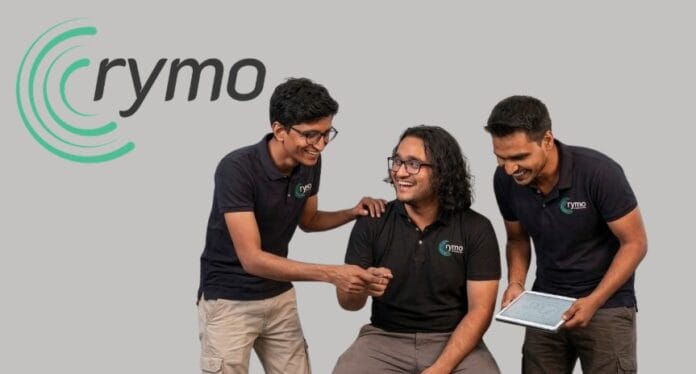
Friday, March 20, 2026: Mumbai-based neuro-rehabilitation startup Rymo Technologies has raised ₹10 crore in a seed funding round led by IAN Group, signaling growing investor interest in tech-driven solutions for neurological recovery.
The fresh capital will be directed toward advancing product innovation, boosting manufacturing capacity, and expanding the company’s footprint across India. Rymo is also preparing to enter international markets, with a focus on ASEAN countries and the Middle East, according to the company.
Rymo’s Fresh Capital Infusion to Bridge Gaps in Neuro-Rehabilitation Sector
Founded in 2020 by Chirag Shah and Abhishek Rai, the startup is building robotic and AI-powered systems designed to improve physical rehabilitation outcomes. Its flagship solution, the Mobi-L system, integrates robotics, virtual reality, and artificial intelligence to assist patients recovering from strokes, injuries, and other neurological conditions in regaining mobility.
Rymo operates in a space facing a critical global shortfall. As neurological disorders and stroke cases continue to rise, access to advanced rehabilitation remains constrained by high equipment costs and a limited pool of trained therapists. The company aims to bridge this gap by delivering scalable and cost-effective solutions.
At the core of its offering is a layered technology stack that combines patented hardware, proprietary algorithms trained on patient data, and modular system architecture. Its multi-joint robotic systems use AI to tailor therapy sessions, with a focus on improving recovery speed and measurable outcomes.
The startup reports growing adoption across India’s healthcare sector, with over 452 device installations and 354 clinical clients. Its systems are currently deployed at prominent institutions such as AIIMS, Apollo Hospitals, and Manipal Hospitals.
To date, Rymo’s technology has supported more than 7,500 patients and delivered upwards of 15,000 therapy hours. Internal studies cited by the company suggest that its solutions can accelerate recovery timelines by as much as 25%, underscoring the potential of robotics-led rehabilitation in modern healthcare.

