

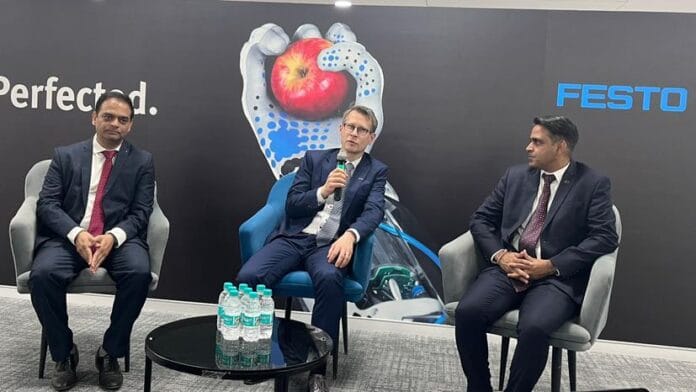
BENGALURU, February 19, 2026: For entrepreneurs tracking the “Global Capability Centre” (GCC) boom, German automation titan Festo just dropped a masterclass in strategic evolution. On Wednesday, the 100-year-old firm inaugurated its 71,000-square-foot GCC near Electronics City, signaling a departure from traditional sales-led expansion toward a high-stakes, software-first innovation model.
While the “land and expand” strategy is common, Festo’s approach offers a unique perspective for startup founders: it’s not about how many people you hire, but the value-density of the talent you retain.
The “Value-First” Scale: Why 600 May Be the New 1,200
Festo plans to scale its Bengaluru workforce from 250 to 600 by 2030, a 2.5x growth target. However, Alok Maheshwari, Head of GCC at Festo India, issued a statement that should resonate with every lean startup founder. He suggested that in the age of AI, “headcount” is a legacy metric.
“Maybe AI might impact things in such a way that 300 people generate the same value that 600 people would have earlier,” Maheshwari noted. For the startup ecosystem, this is a clear signal: Festo isn’t building a back-office; they are building a high-efficiency “Value Engine” where AI-augmented engineers do the heavy lifting.
Key Strategic Pillars for Entrepreneurs:
- Vertical Integration: The centre brings engineering, production, and shared services under one roof.
- Niche Moats: Festo is skipping generic web dev to hire for “embedded AI,” “bionics,” and “industrial cybersecurity.”
- The Learning Company Loop: Eschewing classroom certifications, the firm prioritizes “hands-on” upskilling, a move startups can mirror to bridge the talent gap.
Competing with the Giants: The Impact-Driven Pitch
In a city where Google and Apple set the salary benchmarks, Festo’s recruitment strategy is a lesson in employer branding. Instead of playing the “perks war,” they are selling impact. Sebastian Beck, Member of the Management Board for HR & Finance, argued that talent seeking high-level learning doesn’t need a Silicon Valley badge; they can find the same complexity in industrial robotics and bionics at Festo.
Reflecting 40 years of growth and achievement on his visit to India, Sebastian Beck, Member of Management Board HR & Finance, Festo, celebrated the launch of Festo GCC, “Forty years of Festo in India is a powerful reflection of our long-term vision and belief in the country’s industrial and technological potential. What began as a market presence has evolved into a strong partnership built on trust, engineering excellence, and shared values. As we look ahead, India will continue to play a strategic role in shaping Festo’s global innovation, digital capabilities, and sustainable growth.”
For early-stage founders, this validates a core truth: top-tier talent often prioritizes the “hard problem” over the “big name.”
The Green Bottom Line
Sustainability isn’t just a slide in their deck, it’s operational. Ravi Sastry, MD of Festo India, revealed that 70% of their local manufacturing energy comes from solar. This “Local for Local” strategy, designing and building energy-efficient products in the market where they are sold, positions the Bengaluru hub as a global export base for green-tech software.
With 20 offer letters already out for March and 50+ open roles, Festo isn’t just entering the Bengaluru tech scene; they are attempting to rewrite the rules of how a century-old hardware company can pivot into a software-led future.

