

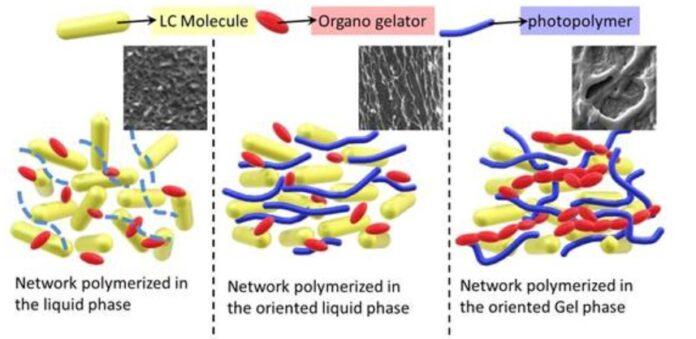
A team of researchers at the Centre for Nano and Soft Matter Science in Bengaluru, India, has developed a novel protocol for confinement of liquid crystals in an architecture called hierarchical double networks of polymers. This new technology could revolutionize the way we think about smart windows, making them more energy-efficient and privacy-protective.
Traditional smart windows use liquid crystals to switch between transparent and opaque states. However, these windows can be expensive and energy-intensive to operate. The new protocol developed by the Indian researchers uses a two-step process to create a hierarchical network that confines the liquid crystals. The first step involves using light to create an orientationally self-assembled polymer network. The second step involves using temperature to induce organogelation, which creates a second network that traps the first one.
The resulting hierarchical network is well-controlled and porous, allowing the liquid crystals to be electrically switched between their direction-dependent states. This means that the windows can be switched on demand between high and low haze states, with very high spatial resolution.
Novel Protocol are more energy efficient and privacy protective
The new protocol could be used to create smart windows that are more energy-efficient and privacy-protective than traditional windows. The windows could be switched to a high haze state to block out light and provide privacy, or they could be switched to a low haze state to allow in more light and reduce energy consumption.
The research team of Dr. D S Shankar Rao, Dr. S Krishna Prasad, and Dr. Varshini G V, at the Centre for Nano and Soft Matter Science, Bengaluru have added a new dimension to this field by introducing double networks which are superimposed on liquid crystals. These networks are realized by two different and independently controlled & on-demand stimuli– light and temperature.
The research team is currently working to scale up the production of the new windows and to develop new applications for them. They believe that the technology has the potential to revolutionize the way we think about smart windows, making them more energy-efficient and privacy-protective.
“We are very excited about the potential of this new technology,” said Dr. D S Shankar Rao, lead author of the study. “We believe that it could revolutionize the way we think about smart windows, making them more energy-efficient and privacy-protective.”
To learn more about the new protocol for smart windows, visit the website of the Centre for Nano and Soft Matter Science.

