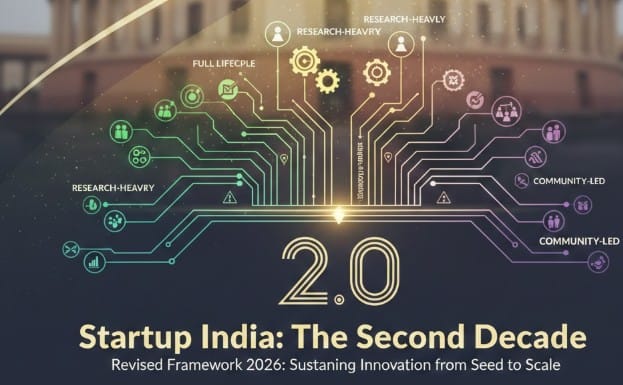
February 8, 2206: As Startup India enters its second decade, the government has quietly but decisively rewritten the rules of engagement. The revised startup recognition framework, announced in February 2026, signals a strategic pivot: from nurturing early-stage ventures to sustaining innovation across the full lifecycle of a company, including research-heavy and community-led enterprises.
Rather than a cosmetic policy update, the new framework reflects a recalibration of how the Indian state views innovation, scale, and inclusion. The message is clear, growth is no longer a disqualifier for support, and innovation is no longer confined to urban, venture-backed tech firms.
Startup India: A recognition system redesigned for scale, science and society
At the heart of the reform is a long-standing friction point for Indian startups: outgrowing government definitions before maturing as innovation-led businesses. By doubling the annual turnover threshold for general startup recognition from ₹100 crore to ₹200 crore, the government has acknowledged a structural reality, many technology companies scale revenues faster than they achieve profitability because capital is continuously recycled into research, product development, and market expansion.
This adjustment keeps startup India ecosystem within the ambit of the Department for Promotion of Industry and Internal Trade (DPIIT) recognition for longer, preserving access to tax holidays under Section 80-IAC, angel tax exemptions, and relaxed compliance norms. For founders, this translates into policy continuity during critical years when capital efficiency and regulatory certainty can determine survival or failure.
The most forward-looking shift in the startup India policy, however, is the formal introduction of a deep tech startup category. These ventures, working in areas such as semiconductors, quantum computing, space systems, and advanced materials, now enjoy an extended eligibility window of up to 20 years and a higher turnover ceiling of ₹300 crore. The framework departs from age-based definitions and instead leans on Technology Readiness Levels as a measure of progress, aligning public policy with the non-linear nature of scientific innovation.
By doing so, the government is effectively recognizing that breakthrough technologies require patient capital, long gestation periods, and sustained policy backing, conditions that traditional startup frameworks often fail to provide.
Equally significant is the inclusion of cooperative societies within the startup India recognition umbrella. Multi-State and State-registered cooperatives can now access benefits previously reserved for private entities, opening the door for technology-driven innovation in agriculture, rural manufacturing, and community enterprises. This move brings women-led self-help groups and farmer collectives closer to formal credit, government procurement through the Government e-Marketplace, and structured mentorship.
The broader ecosystem alignment strengthens this shift. Recent reforms, such as the removal of the three-year eligibility rule under the Industrial Research and Development Promotion Programme and fiscal support announced in the Union Budget 2026–27—tie startup recognition to national research infrastructure, testing facilities, and a ₹1 lakh crore Research Development and Innovation Fund. Together, these measures suggest a deliberate effort to knit startups into India’s long-term industrial and scientific strategy.
A decade after Startup India was launched to lower entry barriers, the focus has clearly evolved. The new framework is less about enabling entry and more about ensuring endurance, supporting companies as they scale, experiment, and embed innovation across sectors and regions. In doing so, India appears to be betting that its next wave of economic growth will come not just from more startups, but from deeper, longer, and more inclusive innovation.

