

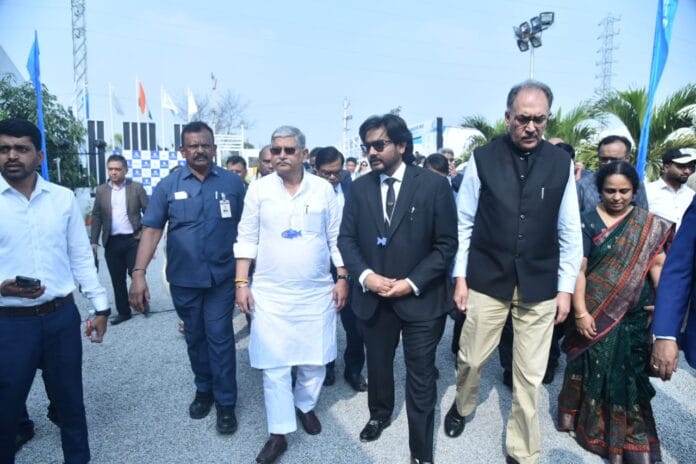
Hyderabad, January 5, 2025: SmartGreen Aquaculture has opened a new inland trout farming facility in Kandukur Mandal on the outskirts of Hyderabad, marking a shift in how cold‑water fish can be produced in warmer regions. The site combines hatchery operations, grow‑out systems, processing units, and a planned microalgae biorefinery on a single campus.
During a visit to the farm on Monday, the scale of the operation was immediately visible. Rows of circular tanks ran across the grow‑out area, each controlled through a recirculating aquaculture system that maintains stable water conditions throughout the year. Workers moved between the hatchery, filtration units, and processing floor as the facility prepared for its first commercial harvest.
The project, built with an investment of about USD 6 million, is designed for an annual capacity of 1,200 metric tonnes of rainbow trout. The company has also set up a research institute and plans to add a skill center focused on RAS technology.
The inauguration drew several central and state leaders, including Union Ministers Rajiv Ranjan Singh (Lalan Singh), G. Kishan Reddy, S. P. Singh Baghel, and George Kurian, along with Telangana Minister Vakiti Srihari. Officials from ICAR, the National Fisheries Department, IFCI Venture Capital Fund, and aquaculture specialists also attended.
SmartGreen Aquaculture Credited for Making Premium Trout Farming a Success in India
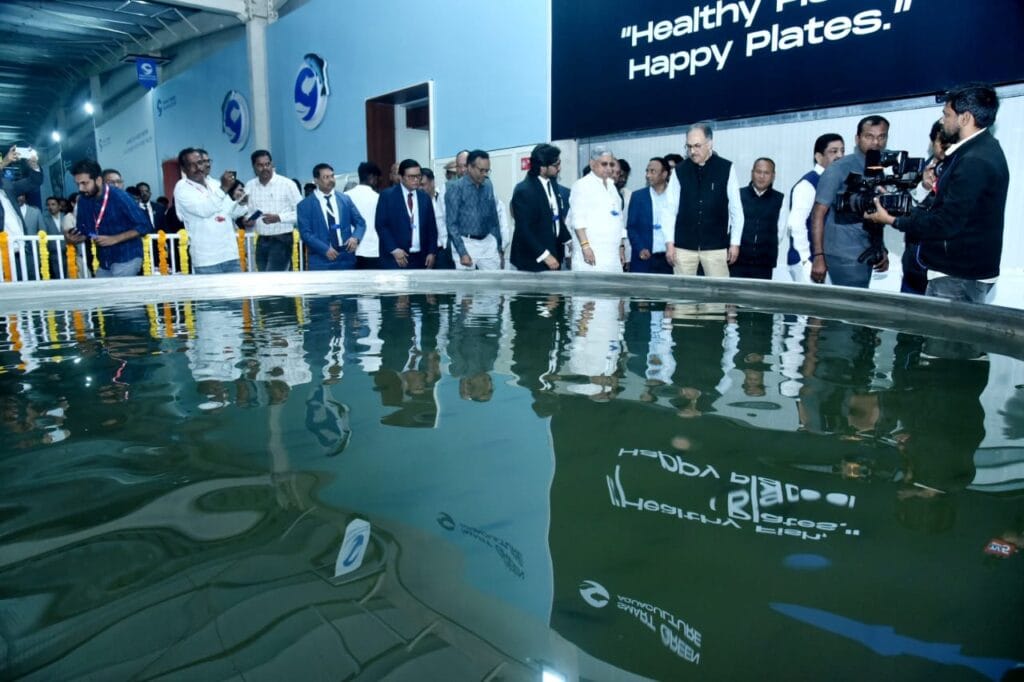
Speaking at the event, Rajiv Ranjan Singh noted that the project reflects the direction in which many young companies are moving, using technology to adapt farming practices to new environments. G. Kishan Reddy added that the initiative shows how engineering and entrepreneurship can open opportunities in specialised aquaculture.
Founder and Managing Director Aditya Rithvik Narra, who guided dignitaries and top ministers from the fisheries ministry through the facility, explained that the farm aims to bring trout production closer to major consumption centers. “Trout farming in India has mostly stayed in colder regions,” he said. “With controlled systems, we can maintain the conditions the species needs and produce consistently through the year.”
The hatchery spans five acres and can produce up to 1.2 million fingerlings annually. The grow‑out area covers two acres and includes 44 tanks ranging from five to ten metres in diameter. The farm employs around 200 people, including technical staff and local workers.
A processing unit at the SmartGreen Aquaculture farm prepares fillets, steaks, skinless cuts, and whole cleaned fish. The company plans to expand its product range and strengthen its direct‑to‑consumer channel through an online store. Narra said the integrated model helps maintain traceability and reduces dependence on external suppliers.
Alongside the aquaculture operations, SmartGreen is developing a microalgae biorefinery that will produce biomass for nutraceuticals, aquafeed, cosmetics, pharmaceuticals, and agriculture. The unit is expected to begin operations between 2026 and 2027.
The farm uses a closed‑loop water system that filters and recycles water continuously. According to Narra, this approach helps maintain stable conditions for trout while reducing the environmental footprint of the operation.
The first phase of the farm, with a capacity of 360 metric tonnes, is nearing the sales stage. The second phase will take production to the full planned capacity. The company plans to serve retail consumers, hotels, and institutional buyers through both offline and online channels.
SmartGreen is also working on developing its own trout egg production capabilities in the next phase. The company has begun training programs for local communities and is exploring compact RAS units for small farmers under a buy‑back arrangement.
India remains one of the world’s major fish‑producing countries, supported by national programs such as the PM Matsya Sampada Yojana and the Blue Economy initiative. The global aquaculture and microalgae sectors continue to expand, creating space for new models like SmartGreen’s integrated inland farm.

