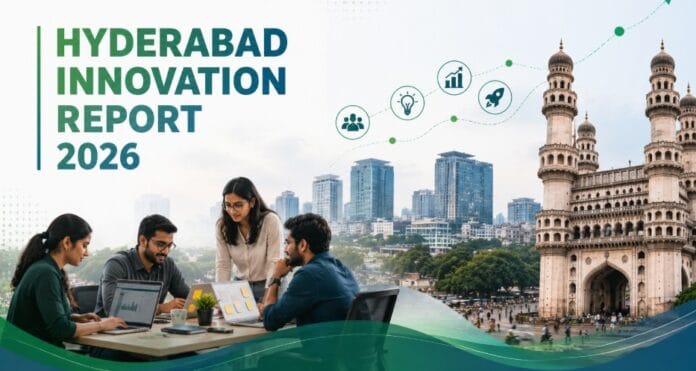
July 29, 2026: Hyderabad: Hyderabad’s startup ecosystem may have produced just two unicorns, Skyroot Aerospace and Darwinbox, but the city is entering a new phase of growth where access to capital and markets, rather than startup creation, will determine its success, according to the Hyderabad Startup Readiness Index 2026.
Released by venture capital firm Endiya Partners as part of the inaugural Hyderabad Innovation Report 2026, the index is based on responses from 216 founders, investors, corporates and ecosystem stakeholders. It gave Hyderabad an overall ecosystem confidence score of 6.5 out of 10, reflecting optimism about the city’s innovation ecosystem while highlighting the challenges startups face as they mature.
The findings suggest Hyderabad has largely built the foundations needed for innovation, with respondents ranking infrastructure and connectivity (43%), talent availability (38%) and cost efficiency (36%) among the city’s biggest strengths. However, the priorities are shifting. Nearly 33% of respondents said improving access to capital should be the ecosystem’s top focus, while 29% identified market access as the next critical requirement.
The report points to a broader transition underway in Hyderabad, from an ecosystem focused on creating startups to one that must now help companies expand into larger domestic and international markets.
The city’s growth over the past decade provides the backdrop for that transition. Hyderabad is now home to more than 10,000 startups and has attracted over $3 billion in venture capital across more than 384 funding deals since 2014. It also hosts over 355 Global Capability Centres (GCCs), accounting for nearly 20% of India’s GCC base, and has emerged as the country’s second-largest technology talent hub.
Only 2 Unicorns, 10,000+ Startups: Hyderabad Enters Scale-Up Phase, Says Startup Readiness Report
The report also highlights Hyderabad’s broader economic strength. The city’s GDP was estimated at $180.5 billion in 2024, supported by $32.2 billion in IT exports. Beyond information technology, Hyderabad has established itself as one of the world’s largest life sciences clusters, producing nearly one-third of the world’s vaccines and 33% of India’s pharmaceutical output. The sector attracted $4.13 billion in investments in 2024, generating around 51,000 jobs.
In the report, Endiya Partners Managing Partners Sateesh Andra and Dr. Ramesh Byrapaneni said Hyderabad has evolved from being a regional technology hub into a global innovation centre over the past decade. They pointed to milestones including the development of the world’s first intranasal COVID-19 vaccine, Skyroot’s historic private space launch, Darwinbox’s emergence as one of Asia’s leading enterprise software companies, breakthroughs in defence technology, and India’s first biobank with more than 200,000 specimens supporting AI-led cancer research. Together, these achievements, they said, demonstrate Hyderabad’s ability to build globally significant, deep-technology innovations.
The report also includes perspectives from founders who credit Hyderabad’s ecosystem for enabling globally competitive businesses.
Skyroot Aerospace Co-founder and CEO Pawan Kumar Chandana said the company chose Hyderabad over Bengaluru because of its mature space and aerospace ecosystem. He noted that access to engineering talent, manufacturing capabilities, government laboratories, proactive policy support, early investors and city infrastructure played a critical role in Skyroot’s growth, describing Hyderabad as the “rocket city” that made the company’s journey possible.
A similar view was shared by Sanjay Nekkanti, Founder and CEO of Dhruva Space, who said Hyderabad’s rise as a space technology hub mirrors the evolution of India’s private space sector. According to him, the city’s engineering talent, research institutions, manufacturing capabilities and rapidly maturing ecosystem have enabled companies like Dhruva Space to build globally competitive space infrastructure businesses from India. As the industry moves towards satellite constellations and space infrastructure, he believes Hyderabad is enabling not just innovation but also large-scale commercial growth.
For enterprise software companies, Hyderabad’s strengths lie in engineering and operational execution. Chaitanya Peddi, Co-founder of Darwinbox, said the city is steadily evolving from a talent hub into a base for globally competitive technology companies, supported by strong engineering capabilities and operational discipline.
The survey also revealed differing perspectives across ecosystem participants. Founders primarily highlighted funding challenges at different stages of growth, while investors pointed to gaps in capital availability across funding cycles. Ecosystem enablers, on the other hand, expressed relatively higher confidence, citing improvements in institutional support and collaboration.
Taken together, the report suggests Hyderabad has crossed the stage where startup formation is its primary challenge. The ecosystem now appears to be entering a scale-up phase, where the availability of growth capital, stronger market access and deeper collaboration between founders, investors, corporates and policymakers will determine whether the city can produce a larger pipeline of globally competitive companies in the years ahead.

