


August 24, 2026: Global semiconductor revenue is on track to surge 92% to $1.6 trillion this year, according to a new Gartner forecast, as AI infrastructure pushes demand far beyond accelerators and into memory, networking, power management and optical technologies.
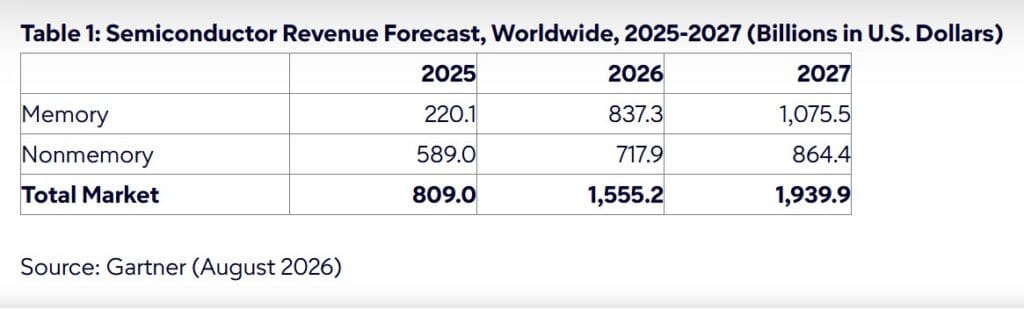
Gartner’s detailed forecast puts 2026 semiconductor revenue at $1.6 trillion, up from $809 billion in 2025, with the market expected to approach $1.94 trillion in 2027. But the bigger story is not the size of the market. It is how AI is changing what the semiconductor industry needs to build.
Memory alone is forecast to generate $837.3 billion in 2026, up from $220.1 billion a year earlier, and surpass $1 trillion in 2027. Gartner expects memory to account for 54% of total semiconductor revenue this year, compared with 27% in 2025.
At the same time, Gartner expects the AI data centre ecosystem’s share of semiconductor revenue to rise from 36.5% in 2026 to more than 53% by 2030. The numbers point to a semiconductor market increasingly being shaped not by a single class of accelerator, but by the infrastructure surrounding AI compute.
That distinction is important because it suggests the next phase of the AI hardware race may be less about simply building a faster GPU and more about redesigning the system around it.
The memory surge changes the AI chip equation
The extraordinary growth in memory is one of the clearest signals. DRAM revenue is forecast to increase 246.6% in 2026, while NAND (non volatile memory) flash revenue is expected to grow 371.9%. Gartner attributes the strength to continued AI infrastructure deployments, higher memory content per AI server and sustained demand for high bandwidth memory, or HBM.
As AI models and workloads become larger, processors increasingly depend on their ability to access and move data efficiently. That makes memory bandwidth, latency and the physical distance between compute and memory critical parts of overall system performance.
Gartner Director Analyst Shrish Pant said AI infrastructure has fundamentally changed the dynamics of the memory market, with tight supply and demand conditions expected to persist as AI deployments increase memory consumption.
The implication is that the value of an AI system can no longer be measured by accelerator performance alone.
AI is expanding the semiconductor stack
The expansion is visible outside memory as well. Gartner forecasts non memory semiconductor revenue to rise from $589 billion in 2025 to $717.9 billion in 2026, a 21.9% increase, before reaching $864.4 billion in 2027.
The beneficiaries include CPUs, networking silicon, power management components, analog devices and optical interconnect technologies. Gartner says the increasingly large, fast and power intensive nature of AI clusters is driving demand across these categories.
Ben Lee, Director Analyst at Gartner, described the change as a structural shift in where semiconductor value is being created, with AI infrastructure reshaping investment across the ecosystem.
That may be the most important takeaway from the forecast. AI is increasingly turning the semiconductor industry into a systems business.
Gartner Semiconductor Report 2026
Gartner’s forecast points to a broader AI infrastructure stack. Source: Gartner
The broader market shift also provides context for the approach being pursued by veteran GPU architect Raja Koduri through OXMIQ Labs.
Koduri, who has held GPU and semiconductor leadership roles at AMD, Apple and Intel, has built OXMIQ around the idea that AI infrastructure needs to be rearchitected across the stack rather than optimized component by component.
OXMIQ describes its approach as spanning energy, data centre infrastructure, silicon IP and software, with the goal of improving the efficiency with which electricity is converted into useful AI computation.
That makes Gartner’s forecast relevant to Koduri’s thinking. If memory is becoming more than half of semiconductor revenue, and AI data centres are expected to represent more than half of semiconductor revenue by 2030, the central challenge is no longer simply how much compute can be packed into an accelerator.
It is how efficiently compute, memory, networking, packaging and energy can be made to work together.
The bottleneck is moving data, not just processing it
Koduri’s architecture approach places particular emphasis on the relationship between compute, memory and interconnect.
OXMIQ’s chiplet architecture, OxQuilt, is designed to let customers configure the relationship between compute, memory and interconnect rather than treating those elements as a fixed design. The company says this allows systems to be optimized for workload, cost, power, bandwidth and latency.
The reasoning becomes more relevant as AI clusters scale. Every time data moves between components, there is an energy and latency cost. Memory access can become increasingly important to overall system performance, particularly as data moves across more complex architectures.
That makes packaging and memory placement architectural decisions, rather than simply manufacturing considerations.
This is also why the rise of High Bandwidth Memory is so important to the AI industry. The market is effectively spending enormous amounts of money to keep increasingly powerful compute fed with data.
The next efficiency gains may therefore come not from adding more raw compute, but from reducing the cost of moving information to where that compute happens.
The Nvidia question is bigger than Nvidia
The dominant narrative around AI hardware has been built around Nvidia’s GPUs and CUDA ecosystem. But Gartner’s numbers suggest that the AI infrastructure opportunity is expanding in directions that cannot be captured by an accelerator alone.
OXMIQ’s strategy is consequently not limited to building another competing chip. The company is developing licensable GPU IP and software intended to let semiconductor companies and AI infrastructure builders develop customized compute platforms without being completely tied to a proprietary accelerator roadmap.
That approach becomes more interesting in a market where memory availability, packaging capacity and power are becoming strategic constraints.
The question is gradually shifting from which GPU is fastest to which architecture gives an AI infrastructure builder the most flexibility per dollar and per watt.
Power is becoming part of the architecture
There is another element to Koduri’s thinking that Gartner’s numbers make harder to ignore: energy. Gartner explicitly points to AI clusters becoming larger, faster and more power intensive.
OXMIQ approaches the issue from a broader systems perspective, arguing that energy generation, power conversion, cooling, data movement and compute should not be treated as disconnected layers.
That perspective matters because the economics of AI increasingly depend on something much more fundamental than processor performance: how many useful tokens or AI operations can be generated from every unit of electricity and every dollar of infrastructure.
As AI data centres move toward increasingly large deployments, energy efficiency stops being merely an operating cost issue. It becomes an architectural constraint.
India could participate beyond fabrication
The changing economics also create a broader opportunity for India. The conventional semiconductor race tends to be framed around fabrication: who can manufacture advanced chips and attract the largest fabs.
But the AI infrastructure stack Gartner describes opens several other avenues, including chip design, GPU IP, advanced packaging, memory integration, networking, software, power systems and data centre architecture.
Koduri’s OXMIQ is positioned across the India US technology corridor, with operations in Hyderabad and Campbell, California. His broader thinking also sees opportunities for collaboration among India, the U.S., Taiwan and South Korea, particularly as advanced memory, packaging, semiconductor manufacturing and architecture become increasingly interconnected.
For India, that could mean participating in the AI hardware economy without having to reproduce every layer of the semiconductor supply chain domestically. The opportunity may be in owning more of the design and systems layer around the chip.
The next semiconductor race will be about the whole system
Gartner’s $1.6 trillion forecast is therefore more than a projection of semiconductor sales. It is a snapshot of an industry being reorganized by AI.
Memory is exploding. AI data centres are taking a larger share of semiconductor demand. Networking and optical technologies are becoming more important. Power management is becoming critical. And the relationship between compute, memory and packaging is becoming central to system economics.
Koduri’s work at OXMIQ offers one way of interpreting where this could lead: AI computing will increasingly be won at the system level, not by one processor in isolation.
The industry’s first AI hardware race was about securing enough accelerators. The next could be about building architectures that make those accelerators, and the memory, networking, software and energy around them, work far more efficiently.
The shift is already beginning to take shape in India. In August, Prime Minister Narendra Modi laid the foundation stone for ASIP Technologies’ ₹2,500 crore OSAT facility in Visakhapatnam, Andhra Pradesh’s first semiconductor manufacturing facility approved under the India Semiconductor Mission. The facility is expected to serve high growth sectors including AI, high performance computing, data centres and high speed communications.
If Gartner is right that AI data centres will account for more than half of semiconductor revenue by 2030, the biggest semiconductor opportunity of the next decade may not belong to the company with the fastest chip.
It may belong to whoever figures out how to make the entire AI machine work better.

