New Delhi, September 30, 2026: The Union Cabinet has approved the third phase of India’s Green Energy Corridor, committing ₹1.86 lakh crore to strengthen state-level power transmission networks and deploy large-scale battery storage as the country prepares to absorb more renewable energy into the grid.
The Green Energy Corridor Phase-III (GEC-III) scheme is designed to enable the evacuation of up to 135 GW of renewable energy across states and Union territories by FY2032-33.
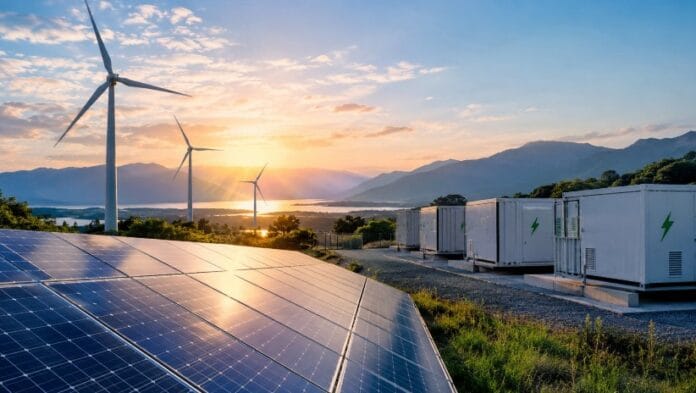
The plan also includes 50 GWh of Battery Energy Storage Systems (BESS), marking a significant expansion of storage infrastructure alongside new transmission capacity. This is where India’s emerging battery-storage startups could become important.
Take Cygni Energy, an Indian energy-storage company that has built a 4.8 GWh-rated BESS manufacturing facility, with a cell-to-container assembly capability and plans to scale beyond 10 GWh.
For renewable-energy companies and startups, the transmission and storage investment could create opportunities beyond solar and wind generation. The government expects the programme to support new activity in energy storage, grid management, transmission technology, construction and operations.
The total outlay comprises ₹1,36,378 crore for intra-state transmission systems and ₹50,000 crore for battery storage. The Centre will provide ₹54,082 crore in financial support under the scheme.
The government says the central assistance will help offset intra-state transmission charges, with the objective of keeping electricity costs lower for end users.
A bigger market for storage startups as GEC-III scheme gets cabinet nod
The inclusion of 50 GWh of BESS is one of the most significant components of the programme for India’s energy-storage industry. The new GEC-III framework could add another layer of demand by supporting 50 GWh of storage specifically for grid flexibility. The opportunity therefore extends beyond large utilities and renewable developers to domestic manufacturers and system integrators capable of supplying and integrating BESS at scale
As solar and wind generation grows, the grid has to manage periods when renewable output does not match electricity demand. Battery storage can be used to shift electricity between hours, manage peak demand and provide additional flexibility to the grid.
Under GEC-III, storage systems can be installed at renewable-energy developer or generator sites, as well as at other strategically important locations on the grid.
That creates potential demand for companies working on battery systems, energy-management software, power electronics, battery integration, monitoring and grid-balancing technologies.
For early-stage companies, the opportunity is likely to extend beyond supplying batteries themselves. Engineering, procurement and construction services, software, forecasting, asset monitoring and operation-and-maintenance services could also become part of the emerging market.
Transmission investment could open procurement opportunities
The transmission component of GEC-III will be implemented through different models depending on the type of project.
Greenfield intra-state transmission projects will be developed through Tariff Based Competitive Bidding (TBCB). Brownfield upgrades and network-strengthening projects will be implemented on a Cost Plus Basis.
State Transmission Utilities will act as the overall implementing agencies, while transmission service providers will participate in competitively bid projects under a Build-Own-Operate-Maintain (BOOM) model.
For startups, this structure matters because much of the immediate opportunity may come through the wider supply chain rather than direct ownership of major transmission assets.
Companies developing grid-monitoring systems, power-management technologies, digital infrastructure, construction solutions and specialised equipment could potentially find opportunities as larger transmission and infrastructure players build out projects.
Storage could become a grid requirement, not just a renewable add-on
The government’s stated objectives for the storage component include addressing renewable intermittency, transmission congestion and peak-hour curtailment, while supplying electricity during non-solar hours.
That could gradually change the role of battery storage in India’s power market. Instead of being viewed only as a component attached to a solar or wind project, storage can increasingly function as grid infrastructure that helps balance supply and demand.
For startups, that shift could support business models around energy-as-a-service, battery management, storage optimisation, forecasting and grid flexibility.
The programme also has a manufacturing angle. The government expects the expansion of BESS deployment to generate additional employment and activity in the domestic energy-storage industry.
Part of India’s larger non-fossil power target, GEC-III is intended to support India’s broader goal of reaching 900 GW of installed non-fossil capacity by 2035.
Building generation capacity alone is not enough to achieve that target. Power produced by renewable projects has to be moved to demand centres and managed when generation and consumption do not coincide.
That makes transmission and storage increasingly important parts of the renewable-energy buildout.
The government expects the programme to create direct and indirect employment across the power, manufacturing and construction sectors, while also creating longer-term skilled jobs in operations, maintenance and grid management.
For India’s startup ecosystem, the significance of GEC-III therefore extends beyond the headline investment figure. The combination of 135 GW of renewable-energy evacuation capacity and 50 GWh of storage points to a growing market for companies building the digital, hardware and services infrastructure needed to operate a more renewable-heavy electricity system.

