

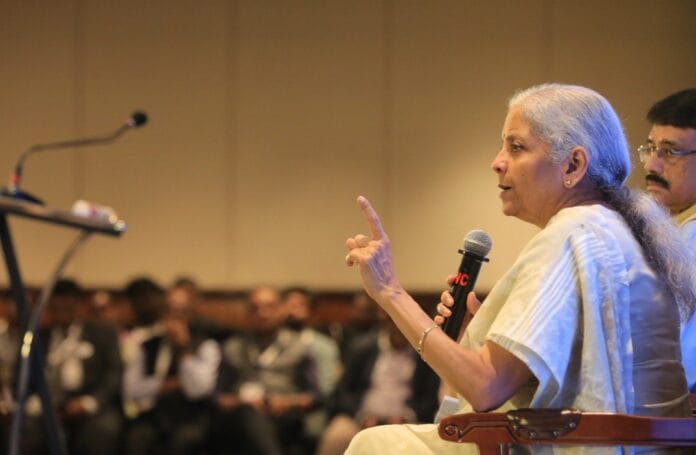
BENGALURU: September 28, 2026: Finance Minister Nirmala Sitharaman has urged Indian technology startups to look beyond early- and late-stage fundraising as they scale, and consider public-market listings as part of their longer-term growth plans.
Speaking at the IIT Madras Alumni Association’s Sangam 2026 in Bengaluru, Sitharaman said India’s startup ecosystem has evolved significantly since 2015 and could play a much larger role in the economy over the next few years. She said Indian startups could potentially contribute as much to the economy as some established industries.
Sitharaman said innovations developed by startups need to move beyond individual companies and find wider applications across the economy. She pointed to areas such as agriculture and drones as examples of technologies developed by young companies that can be deployed across sectors.
The finance minister also encouraged technology founders to think about the eventual transition from private capital to public markets. Founders building technology companies, she said, should not have to spend a significant portion of their time managing fundraising, administrative responsibilities and other functions that could be handled by specialised partners.
Nirmala Sitharaman Sees Bigger Economic Role for Startups
She urged startups to consider stock-market listings where appropriate, arguing that a larger pool of listed technology and artificial intelligence companies could make India’s progress in these areas more visible globally.
Sitharaman also pushed back against using the number of listed AI companies as a measure of India’s position in artificial intelligence. She said the country already has AI companies that have reached unicorn status or are approaching that level, suggesting that public-market representation does not by itself capture the extent of innovation taking place in the sector.
The comments come as India’s startup ecosystem increasingly expands into capital-intensive areas such as deeptech, hardware, semiconductors, space and artificial intelligence. These businesses often require significantly longer development cycles and larger amounts of capital before they can generate meaningful commercial revenue.
On the challenge of patient capital for deeptech and hardware startups, Sitharaman sought specific recommendations from the startup ecosystem on the timing and scale of early-stage funding. Responding to a question about companies that can take several years to generate revenue, she asked founders and industry participants to define what should qualify as “early” funding and how much capital would be sufficient.
Sitharaman asked the ecosystem to submit its recommendations within 10 days, indicating that specific proposals could help shape the government’s approach to addressing the funding gap faced by capital-intensive startups.
She also pointed to the space sector as an example of how opening previously restricted areas to private participation can create opportunities for startups. Young companies are now involved in satellite development and space missions, while the defence sector could offer further opportunities for private and public capital, Nirmala Sitharaman said.
Beyond funding, Nirmala Sitharaman highlighted the need to build the infrastructure required for India’s next phase of technology adoption. She said greater investment would be needed in artificial intelligence infrastructure, including hardware, as well as skills and training to help businesses adopt AI.
AI, semiconductors and quantum computing are among the technology areas where infrastructure investment will be increasingly important, she said.
For India’s startup ecosystem, the Finance Minister Nirmala Sitharaman‘s comments point to a broader shift in the conversation around growth. While access to venture and growth capital remains critical, the focus is increasingly moving towards building companies capable of scaling across sectors, commercialising technology, attracting patient capital and eventually accessing public markets.
The transition from fundraising to sustained scale and market participation could therefore become an increasingly important part of the next phase of India’s startup story.

