


HYDERABAD, India, September 9, 2026: Indian deep tech company Hylenr Technologies says it has found evidence corresponding to 32 chemical elements in materials used in its nuclear fusion research, including the rare earth element yttrium.
The results come after 10 years of work on nuclear fusion using lattice confinement technology, in which hydrogen is loaded into engineered metal structures. Hylenr says the latest analysis could point to nuclear processes taking place within the material itself, potentially opening a new area of research beyond fusion energy.
“What makes this finding exciting is the possibility of bringing together Nuclear Fusion Energy and Rare Earth materials within one engineered nuclear platform,” said Siddhartha Durairajan, Co founder and Board Member of Hylenr Technologies.
“For thousands of years, access to an element has been determined by whether nature concentrated it somewhere in the Earth’s crust. We are working toward a very different future, one in which we can engineer the material environment required to create selected elements,” Siddhartha added.
What comes next for Hylenr Technologies and its research
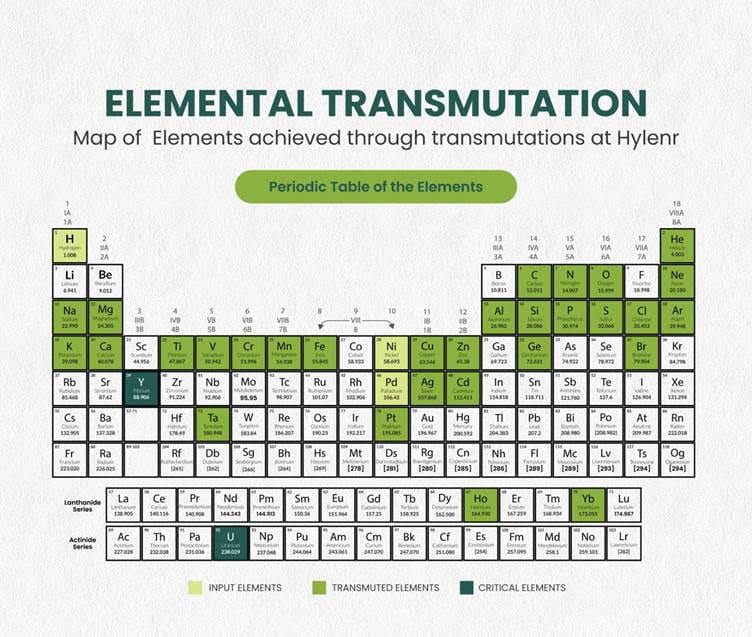
The work, titled “Nuclear Signatures in a Hydrogen Loaded Ni Pd Lattice Confinement System,” was presented earlier this month at the 27th International Conference on Condensed Matter Nuclear Science (ICCF 27) in Niagara Falls, Canada.
According to Hylenr Technologies, the company detected signatures corresponding to 32 elements in samples examined after the experiments. The list includes light elements, noble gases such as helium, neon and argon, yttrium and actinides including uranium.
The company compared the post experiment samples with the same catalyst material before it was used. It says the observations were examined using several analytical techniques, including Energy Dispersive X ray Spectroscopy, X ray Photoelectron Spectroscopy, Inductively Coupled Plasma Optical Emission Spectroscopy, Wavelength Dispersive X ray Spectroscopy and Residual Gas Analysis.
The research is based on lattice confinement fusion, an approach that looks at nuclear reactions in metal lattices containing hydrogen. Hylenr says its work over the past decade has included collaborations with international research institutions.
The findings are potentially significant because they raise the possibility of using engineered materials not only to study fusion reactions, but also to investigate whether one element can be transformed into another under controlled conditions.
Ram Ramaseshan, Co founder and Board Member of Hylenr Technologies, says: “Rare earth elements are critical to technologies ranging from electric vehicles and robotics to electronics, aerospace and defence. But their supply chains remain highly concentrated, creating strategic dependence for countries looking to scale clean energy and advanced manufacturing.”
Such a process, known as nucleosynthesis or nuclear transmutation depending on the mechanism, is normally associated with extreme environments or high energy systems. Hylenr is investigating whether its lattice based approach can produce similar nuclear effects under much more compact conditions.
Rare earth elements are widely used in permanent magnets, electric vehicles, robotics, electronics, aerospace, defence and renewable energy. Their supply chains are concentrated in a relatively small number of countries, making access to these materials an increasingly important industrial and strategic issue.
For India, a technology that could eventually enable the controlled production of selected elements could have implications for defence, electronics, electric mobility, renewable energy, space and advanced manufacturing.
Hylenr is not claiming that it has established commercial production of rare earth elements. The current work reports evidence of elemental signatures in experimental materials, and further research is needed to establish whether the observations are the result of controlled nuclear processes.
The company says its next steps will focus on reproducing the observations, understanding the mechanism behind them and determining whether the process can be controlled and developed further.

