

October 25, 2026: India’s technology ecosystem is seeing activity across early-stage funding, enterprise artificial intelligence and deeptech, even as global capability centres (GCCs) prepare for another phase of workforce expansion. Two startup funding deals totalling Rs 6.7 crore, a planned 2 GW data centre build-out and fresh investments in AI-led business applications reflect the breadth of opportunities attracting capital and corporate attention.
GVFL has led a Rs 3.7 crore seed funding round in Ahmedabad-based SpectraGaze Systems, while Hyderabad-based venture capital fund haf.vc has invested Rs 3 crore in conversational AI startup Hunar.AI. The deals span two distinct segments of the technology market: specialised imaging systems for space and defence, and AI tools designed to automate frontline workforce management.
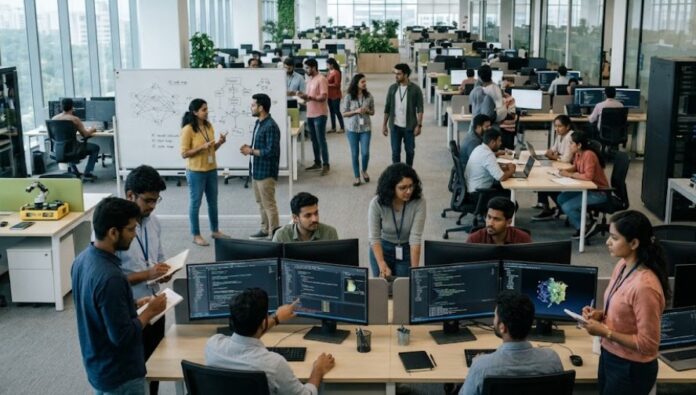
The funding activity comes against the backdrop of an expanding GCC ecosystem. India’s GCC workforce is projected to increase from 2.3 million to between 3.3 million and 3.7 million by 2031, adding one million to 1.4 million net jobs, according to an Embark report. The expansion could also generate demand for an additional 150 million to 170 million square feet of office space.
Together, the developments point to a technology market that is growing beyond software services, with investment flowing into specialised engineering, enterprise automation and the physical infrastructure needed to support AI workloads. The challenge for companies will be converting that investment and adoption into measurable commercial outcomes.
GVFL backs SpectraGaze as Indian Startups builds domestic space-tech capabilities
GVFL has led a Rs 3.7 crore seed round in SpectraGaze Systems, an Ahmedabad-based startup developing indigenous optical imaging sensors and electro-optical payloads for space, defence and scientific applications. Angel investors also participated in the round.
Founded in 2023 by former ISRO scientist Arup Banerjee, the company has already established relationships with customers including ISRO, Physical Research Laboratory and Kaynes Technology. It has delivered an infrared detector and test system to ISRO and secured an image sensor development contract for the agency’s HRSAT programme.
SpectraGaze will use the capital to advance product development, expand its engineering team, strengthen testing infrastructure and execute existing customer projects. It is also developing a hyperspectral imaging camera for a 3U satellite.
The company operates in a specialised segment where technical expertise and customer qualification can create barriers to entry, but product development cycles are often long and commercialisation requires sustained investment. Its existing institutional and industrial engagements offer a foundation for growth, although the scale of future contracts and its ability to expand beyond individual projects will be important to watch.
For investors, the opportunity lies in the development of domestic capabilities in areas where advanced sensors and imaging systems have applications across space programmes, defence platforms and scientific research. The next stage for SpectraGaze will be to demonstrate that its engineering capabilities can translate into repeat business and a wider commercial pipeline.
haf.vc invests Rs 3 crore in Hunar.AI
Hyderabad-based haf.vc has invested Rs 3 crore in Hunar.AI, a conversational AI startup developing tools for frontline workforce management.
Founded in 2022 by Krishna Khandelwal and Shantanu Bhattacharyya, Hunar.AI builds AI agents that help enterprises hire, onboard, train and engage frontline workers through voice and WhatsApp. Its target market includes businesses in sectors such as logistics, retail and services, where large, distributed and multilingual workforces create recurring recruitment and communication challenges.
The funding will support AI infrastructure, product development, sales and market expansion. The company intends to strengthen its presence in Hyderabad and Telangana.
Kalyan Sivalenka, managing partner at haf.vc, said the startup’s understanding of workforce challenges and its technology-led approach made it an attractive investment. Co-founder and CEO Krishna Khandelwal said the capital would help the company expand its regional presence and product capabilities.
The investment reflects a broader enterprise AI opportunity: applying automation to specific business processes rather than relying solely on general-purpose AI tools. For companies employing large numbers of frontline workers, conversational systems can potentially streamline recruitment, training and routine communication.
However, commercial adoption will depend on whether these tools deliver measurable improvements in hiring time, employee engagement and operating costs. The ability to work reliably across languages and integrate into existing business systems will also influence how quickly customers expand their use.
GCCs project up to 1.4 million net new jobs by 2031
India’s GCC ecosystem is expected to expand significantly over the next five years, with employment projected to rise to between 3.3 million and 3.7 million by 2031 from 2.3 million, according to an Embark report.
Based on a survey of 100 GCC leaders, the report found that 92% had moved beyond selective AI adoption. However, realised productivity gains remain below 15%, indicating that wider deployment has yet to translate into equivalent improvements in measurable business performance.
Around 80% of anticipated workforce additions are expected to come from existing centres. Demand is also shifting towards specialised roles in artificial intelligence, data and cybersecurity, suggesting that the next phase of expansion will require more than simply adding headcount.
Bengaluru and Hyderabad account for 67% of Tier I GCC leasing, while banking, financial services and insurance, alongside technology, media and telecommunications, are expected to drive 54% of incremental office demand.
The projections have implications for both the technology labour market and commercial real estate. GCCs are increasingly involved in specialised technology and business functions, while their expansion supports demand for office space, engineering talent and related services.
Yet the productivity findings introduce an important qualification. If companies are increasing AI adoption without achieving comparable efficiency gains, the emphasis may shift towards workforce reskilling, workflow redesign and stronger measurement of returns. Future hiring will depend not only on expansion plans but also on how companies balance additional specialist roles with the automation of existing tasks.
Honasa Consumer strengthens technology leadership for AI transformation
Honasa Consumer has elevated Vipul Maheshwari to chief product and technology officer, giving him responsibility for product, technology, engineering and analytics.
Maheshwari has spent six years at Honasa, building its data and product capabilities. In his new role, he will lead the company’s AI-led transformation and the development of agentic AI systems intended to automate workflows, improve decision-making and increase operational efficiency.
Before joining Honasa, he held roles at Delhivery and Global Analytics India. He holds a master’s degree in mathematics and computer science from IIT Delhi.
The appointment highlights how AI investment is extending into consumer businesses, where technology teams are increasingly expected to support operational decisions and execution rather than focus solely on digital products. The commercial test will be whether these initiatives improve efficiency and business performance at scale.
Microsoft, MeitY Startup Hub and 1M1B launch AI and green-skills centre
Microsoft, MeitY Startup Hub and the 1M1B Foundation have launched a Green Skills and Applied AI Centre of Excellence at SAS iTower in Hyderabad, including a dedicated AI and Green Pharma training track.
The centre will offer practical training in applied AI, pharmaceutical manufacturing, solar energy, electric vehicles and wind energy, alongside industry mentoring, internships and employment pathways. At the launch, 1M1B Jobs Express reported 100 job offers on its first day.
The Hyderabad facility is part of a planned network of five centres targeting 100,000 young people for training in AI and green skills by 2030.
The initiative comes as employers face a growing need for workers who can apply AI tools in operational settings while also supporting emerging industries tied to energy transition and advanced manufacturing. The long-term measure of success will be how many trainees secure relevant jobs and whether employers can use the programme to address specific skills gaps.
Cortex DC plans 2 GW of data centre capacity
Cortex DC, the AI-focused subsidiary of The Chatterjee Group, has entered the data centre sector with plans to develop 2 GW of capacity across India. The company is targeting hyperscalers, cloud service providers and advanced AI workloads.
It aims to bring its first data centre to operational readiness within 18 months of construction commencing and plans to source 51% of its energy from green sources.
Chief executive Rahul Sharma said the company aims to deliver scalable, resilient and AI-ready infrastructure for domestic and international customers. Its development plans are also expected to generate direct and indirect employment across construction, engineering, supply chains and facility operations.
The proposed capacity reflects the growing importance of computing infrastructure as AI workloads increase demand for processing power, cooling and reliable energy. However, the 2 GW figure represents a development ambition rather than operational capacity already available in the market.
Execution will depend on securing land, power, financing and customer commitments, while the company’s renewable-energy plans will need to be assessed alongside the energy requirements of large-scale data centre operations.
Deeptech investors look beyond India for expansion opportunities
Unicorn India Ventures has launched operations in the US to help Indian deeptech startups access international investors, technology networks and expansion opportunities. The firm has appointed former Google executive Kishore Kanakamedala as venture partner to lead the expansion.
Kanakamedala will build a team of mid-to-senior professionals, develop relationships with investors and technology ecosystems in the US, and help portfolio companies explore international markets.
The move follows the closure of the firm’s third fund, worth Rs 1,200 crore, earlier this year. Unicorn India Ventures said it observed significant interest among US investors in Indian deeptech companies during fundraising.
The firm invests in early-stage businesses across semiconductors, space, defence, healthcare, robotics and agritech. It manages approximately $350 million across its funds and has backed 54 companies.
For deeptech businesses, overseas expansion can provide access to specialised customers, strategic partners and capital pools that may be harder to reach from India alone. However, these companies must also navigate longer sales cycles, regulatory requirements and the cost of establishing an international presence.
The firm’s US expansion will therefore be important not just as a geographic move, but as a test of whether Indian deeptech startups can convert global investor interest into commercial partnerships and international revenue.
Delhivery and Peak XV target logistics and industrial AI startups
Delhivery and Peak XV Partners have launched Demo Day, powered by Amazon Web Services, to support startups developing technologies for supply chains and logistics.
The initiative will focus on AI applications in logistics, robotics and industrial automation. Selected startups will have the opportunity to present their solutions to company leaders and may receive mentorship, cloud infrastructure support, potential investment and access to live logistics environments through Delhivery’s network.
For startups developing industrial technology, real-world testing can be a critical step between a working prototype and a commercially viable product. Logistics networks offer complex operating conditions in which companies can assess reliability, integration requirements and potential efficiency gains.
The programme’s longer-term impact will depend on whether participating startups move from demonstrations to paid pilots and broader deployments.
ZFunds enters US stocks and ETFs as overseas investing gains traction
Wealth management platform ZFunds has launched access to US-listed stocks and exchange-traded funds, reporting around 5,000 new account openings on the first day.
The offering gives Indian investors access to securities including Apple, NVIDIA, Amazon, Microsoft, Meta and Berkshire Hathaway, alongside ETFs. ZFunds is integrating the service into its wealth manager-led model, allowing customers to manage international investments through the financial professionals handling their broader wealth requirements.
CEO and co-founder Manish Kothari said international diversification could improve risk-adjusted returns and provide exposure to themes such as AI and semiconductors.
The company cited Reserve Bank of India data showing that overseas equity and debt investments under the Liberalised Remittance Scheme increased 56% to approximately $2.65 billion in FY26.
The launch adds another option for investors seeking international market exposure. However, initial account openings are only an early indicator of demand; funded accounts, recurring investment activity and customer retention will provide a clearer picture of adoption.
Purple Finance expands MSME lending as AUM doubles
Purple Finance reported a 101% year-on-year increase in standalone assets under management to Rs 329.21 crore in the first half of FY27. Its board has also approved exploring an entry into affordable housing finance through an acquisition, investment or subsidiary, subject to regulatory approvals.
The NBFC has introduced PURPLE SARAL, offering MSME loans of Rs 75,000 to Rs 2 lakh, and SAKSHAM LAP, providing mortgage loans of Rs 2 lakh to Rs 4 lakh. It has also begun institutional lending to NBFCs serving MSMEs.
Gross non-performing assets remained below 2.5%, according to the company. Following its acquisition of Saksham Gram Credit, combined AUM reached Rs 853 crore across 205 branches.
The proposed expansion into affordable housing finance could diversify the company’s lending activities, although the impact will depend on funding costs, underwriting standards and acquisition economics. As the business grows, maintaining asset quality will remain central to sustaining the expansion.
Lenskart opens first concept flagship store in India
Lenskart has opened Lenskart evolv at Worli in Mumbai, its first concept flagship store in India. The format combines eyewear retail with design, technology and fashion, featuring chrome-finished interiors and interactive installations.
The store offers AI-assisted eye testing, remote optometrist consultations and a digital shopping assistant, while also using Tango Eye technology to support the shopping experience.
Chief executive Peyush Bansal said the concept is intended to broaden how customers discover and experience eyewear. The company plans to explore a limited number of similar stores in the future.
The launch adds an experience-led format to Lenskart’s retail strategy. Its commercial value will depend on whether the technology and store design improve customer engagement and conversion enough to justify the investment required to operate the concept.
What the latest developments signal
The latest funding and expansion announcements show that India’s technology ecosystem is developing along several connected tracks. Investors are backing specialised deeptech and enterprise AI startups, companies are embedding AI into their operating models, and infrastructure providers are preparing for increased demand for computing capacity.
The workforce outlook adds another dimension to that growth story. The projected addition of up to 1.4 million net GCC jobs by 2031 suggests that demand for specialised technology and business talent could remain substantial, even as AI reshapes the nature of work. At the same time, the reported gap between AI adoption and realised productivity gains indicates that technology deployment alone will not guarantee better business outcomes.
For startups, the focus will increasingly be on customer adoption, repeat revenue and the ability to scale beyond early contracts. For investors, the key considerations will be execution, capital efficiency and the time required to turn technology into sustainable returns.
The direction of travel is clear: India’s opportunity is no longer confined to supplying technology talent or developing software. It increasingly includes building advanced products, deploying AI in business operations and developing the infrastructure required to support the next phase of digital growth. The scale of the opportunity, however, will ultimately be determined by what companies can deliver, not simply what they announce.

