

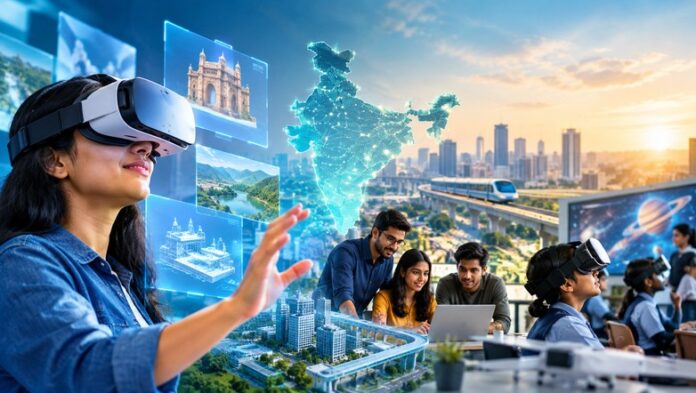
New Delhi, October 27, 2026: India’s immersive tech industry is moving beyond gaming and entertainment, with applications emerging in education, healthcare, tourism, infrastructure planning and digital content creation. Government-backed programmes, new training initiatives and growing startup support are helping build the ecosystem, while market projections point to a significant commercial opportunity over the next four years.
India’s immersive technology market generated $1.26 billion in revenue in 2023 and is projected to reach $7.82 billion by 2030, growing at a compound annual growth rate of 29.8%, according to figures cited in the source material. The country is also projected to be the fastest-growing regional market in Asia-Pacific.
For startups, the opportunity extends beyond developing virtual reality headsets or augmented reality applications. It includes building software platforms, digital simulation tools, spatial computing applications, interactive learning products and solutions that help businesses model real-world environments before making expensive decisions.
The market’s growth comes as India looks to build on its digital public infrastructure, including UPI, Aadhaar, DigiLocker, UMANG and BHASHINI. These platforms have expanded access to digital services. Immersive technologies could take the next step by making digital interactions more visual, interactive and practical.
Virtual reality (VR) creates a computer-generated environment in which users can explore simulated spaces. Augmented reality (AR) overlays digital information on the physical world, while mixed reality (MR) allows digital objects to interact with real surroundings. Extended reality (XR) is the broader term covering these technologies.
Their commercial value will depend on how effectively they address real problems. In education, that could mean helping students understand complex scientific concepts through three-dimensional simulations. In industry, it could involve training workers in simulated environments. In infrastructure, digital replicas of cities could help planners evaluate transport patterns and assess the likely impact of development projects.
The government is expanding support for the wider Animation, Visual Effects, Gaming, Comics and Extended Reality (AVGC-XR) sector through talent development, startup programmes and infrastructure initiatives. The Ministry of Information and Broadcasting is promoting the ecosystem, with the Indian Institute of Creative Technologies (IICT) in Mumbai serving as a National Centre of Excellence.
Established in 2025, IICT works with global technology companies, including Google, Meta, Adobe and Netflix, to strengthen creative education and innovation. As of March 2026, the institute had introduced 18 courses across AVGC-XR domains, with more than 135 students enrolled.
The government has also allocated ₹250 crore in the Union Budget 2026–27 for AVGC Content Creator Labs in 15,000 secondary schools and 500 colleges. IICT will serve as the nodal agency for planning, coordinating and implementing the initiative.
The investment could help expose students to animation, visual effects, gaming and digital content production earlier in their education. For startups, the larger significance lies in the possibility of developing a wider talent pool for an industry that requires a mix of technical, artistic and design skills.
However, access to training facilities alone will not guarantee a competitive workforce. Startups and employers will need graduates who can build commercially usable products, work with industry-standard tools and solve problems across software development, design and immersive content production.
Startup support is another part of the policy push. The Ministry of Electronics and Information Technology’s GENESIS programme, launched in 2022, aims to support around 1,600 technology startups over five years, with a focus on emerging technology businesses in Tier-II and Tier-III cities. The source material states that the programme supports 84 AR/VR startups through the MeitY Startup Hub and backs 106 incubators across the country.
WaveX, a media-tech startup accelerator and incubator launched by the Ministry of Information and Broadcasting, is also intended to help businesses working in AVGC-XR and related media technologies strengthen their products and explore market opportunities.
For early-stage companies, the challenge will be turning prototypes into products that customers are willing to pay for. Education providers, industrial companies, museums and infrastructure agencies could offer potential markets, but each has different requirements around cost, deployment, technical integration and ongoing support.
India’s education sector is already providing examples of how immersive technology could be used beyond entertainment. Researchers at IIT Madras are developing AR- and VR-enabled learning solutions for rural schools, with a focus on secondary-level subjects including history, social science, science and languages.
Virtual environments could allow students to explore the solar system, examine three-dimensional models of the human body or study historical settings in ways that conventional classroom materials cannot easily reproduce. AR applications could also overlay maps, archival material and digital reconstructions onto familiar surroundings.
The commercial question is whether these solutions can be delivered at a price schools can afford and used effectively by teachers. Products that require expensive equipment, reliable high-speed connectivity or extensive technical support may face adoption barriers, particularly in rural and resource-constrained settings. Mobile-based applications and reusable learning content could offer more accessible routes to deployment.
The heritage and tourism sectors present another opportunity. The government has been digitising museum collections through JATAN software, with eight national-level museums and two Archaeological Survey of India museums digitised, according to the source material. Their collections are accessible through the Museums of India digital repository.
India Builds Its Immersive Tech Ecosystem With Startup Policy Push
The Indian Museum in Kolkata has introduced AI-based interactive features and AR tools and has worked with Google Arts & Culture on a virtual exhibition. Mobile-based virtual tours are also available at Archaeological Survey of India museums in Hampi, Karnataka, and Nalanda, Bihar.
For startups, such projects point to potential demand for virtual exhibitions, interactive storytelling, digital conservation and location-based visitor experiences. Museums and tourism organisations could use these tools to reach audiences unable to visit in person, while physical venues could use them to enrich the visitor experience.
Infrastructure planning may provide a different, potentially significant market for immersive technologies. The Department of Telecommunications’ Sangam: Digital Twin initiative combines digital twin technology with 5G, the Internet of Things and AI to support infrastructure planning. A digital twin is a virtual representation of a real-world object, system or location that uses data to help monitor conditions and assess possible changes.
The Varanasi Urban 3D Spatial Planning project is one example of digital twin mapping in urban planning. The government’s longer-term ambition is to develop a National Digital Twin for major urban centres by 2035.
At India Mobile Congress 2025, the Department of Telecommunications showcased a Mobility Digital Twin that used telecom-derived mobility data to examine how people move through different areas. Demonstrations in Delhi explored commuting patterns and metro station catchment areas, while analysis in Ayodhya examined tourist flows, travel modes and stay patterns.
These applications could create opportunities for startups developing geospatial software, simulation platforms, data visualisation tools and infrastructure analytics. Urban authorities could use such systems to assess transport links, identify mobility patterns and make better-informed planning decisions before committing resources to physical projects.
Yet digital twins require more than sophisticated visual models. Their usefulness depends on the quality of underlying data, how frequently it is updated and whether the results can be integrated into actual planning decisions. Startups entering this market will need to demonstrate measurable value rather than simply produce detailed digital representations.
The entertainment sector remains an important part of the opportunity. India’s gaming industry is projected to grow from $3.8 billion in 2024 to $9.2 billion by FY29, according to an independent report cited in the source material. The government’s wider AVGC-XR strategy, along with national platforms such as the WAVES summit, is intended to strengthen the country’s creative and digital media capabilities.
State-level policies are also shaping the landscape. Karnataka’s AVGC-XR Policy 3.0 includes support for skills, infrastructure and production, while its KITVEN AVGC Fund has a ₹20-crore corpus for investments in companies working in the sector.
Maharashtra’s AVGC-XR Policy 2025 outlines a financial plan of ₹3,268 crore and a vision extending to 2050. Telangana has built an AVGC and gaming ecosystem around Hyderabad, supported by its IMAGE policy and infrastructure. Tamil Nadu’s 2026 policy targets more than 200 startups and approximately two lakh jobs, while Kerala’s policy focuses on talent development and specialised training.
Other states are pursuing their own strategies. Uttar Pradesh is developing an AVGC-XR Park in Jewar, near Noida International Airport and the proposed International Film City. Rajasthan’s policy includes production incentives for eligible AR, VR, animation and game-development projects, while Madhya Pradesh and Gujarat are developing measures to attract investment and strengthen skills and infrastructure.
The spread of these initiatives could give startups more options for locating operations, accessing training facilities and seeking policy support. It could also intensify competition among states to attract companies, investment and skilled workers.
The next opportunity to discuss these developments at a national level comes at the Emerging Science, Technology and Innovation Conclave (ESTIC-2026), scheduled for October 27–29 at Bharat Mandapam in New Delhi. Organised by the Council of Scientific & Industrial Research, the second edition will bring together researchers, industry leaders, innovators, deep-tech startups and government representatives. One of its 12 thematic areas is “Immersive Tech: Generative XR and Spatial Computing.”
For India’s startup ecosystem, the bigger test is whether growing policy support can translate into businesses with sustainable revenue, products that customers adopt and technologies that compete internationally. Training labs and funding programmes can help build the foundations, but commercial success will also depend on product quality, access to customers, intellectual property and the ability to scale.
India has a growing digital base, a large potential user market and an expanding network of creative technology initiatives. If these strengths translate into commercially viable applications, immersive technology could become more than an extension of the gaming industry. It could open new markets for Indian startups across education, industry, tourism, infrastructure and digital services.

