

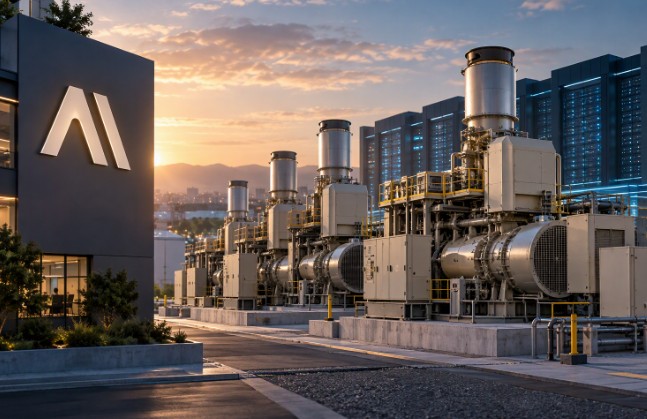
November 10, 2026: Anthropic’s reported $3.4 billion acquisition of natural gas turbine generators marks a significant shift for a company that has traditionally preferred an asset light approach. The move is not just about power generation. It is a signal that securing energy has become as important as securing chips in the race to build advanced AI systems.
In the AI industry, access to computing power was once considered the ultimate competitive advantage. Today, the real battleground appears to be electricity.
According to reports, Anthropic is acquiring Caterpillar generators originally ordered by power equipment supplier OnePWR. The assets are capable of producing up to 1.7 gigawatts of electricity, enough to power massive AI data center operations at a time when access to energy infrastructure is becoming increasingly constrained.
The acquisition stands in stark contrast to Anthropic’s earlier strategy. Rather than owning infrastructure, the company largely relied on partnerships and long term service agreements. Earlier disclosures showed Anthropic committing billions of dollars to rent computing capacity from external providers, underscoring its preference for flexibility over ownership.
That philosophy appears to be changing.
From a startup perspective, the deal reflects a broader transformation taking place across the AI ecosystem. What began as a software race has rapidly evolved into an infrastructure race. Founders once worried about hiring talent and raising capital. Today’s AI leaders are increasingly concerned about securing electricity, land, data centers and long term energy contracts.
Why Anthropic Just Bought 1.7 GW of Energy Capacity
The timing is notable. Demand for AI computing continues to surge, while supply constraints are spreading beyond semiconductors. Natural gas turbines face multi year backlogs, and grid connection queues in several regions stretch far into the future. For companies betting their future on ever larger AI models, waiting is no longer a viable strategy.
Viewed through that lens, Anthropic’s acquisition looks less like an expansion and more like a defensive move. By taking direct control of power generation assets, the company reduces its exposure to a market where energy availability is becoming a critical bottleneck.
The development also highlights a growing divide in the AI industry. Large well funded players are increasingly able to lock up strategic resources through billion dollar investments, while smaller startups may find themselves competing for whatever capacity remains. Access to energy is emerging as a moat that could prove just as valuable as proprietary models or exclusive datasets.
Anthropic is not alone in making this shift. Major technology companies including Google, Amazon, Microsoft and Meta have all moved aggressively to secure dedicated energy supplies for their data center operations. The trend reflects an industry wide realization that public power grids may struggle to keep up with the demands of next generation AI infrastructure.
However, the strategy is not without risk. Natural gas prices remain volatile, and growing dependence on fossil fuel powered infrastructure exposes companies to both economic and regulatory uncertainties. If energy markets tighten or prices spike later in the decade, today’s billion dollar acquisition could become a much more expensive bet.
For now, though, Anthropic’s decision sends a clear message: in the age of artificial intelligence, owning the power source may be just as important as owning the technology itself.

