

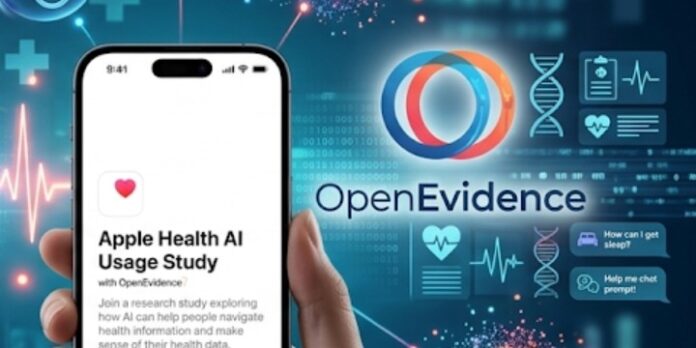
November 16, 2026: AI health startup OpenEvidence is partnering with Apple on a new research initiative that could offer a glimpse into how the iPhone maker plans to approach artificial intelligence in healthcare. The two companies have launched an experimental AI powered health app in the US, giving consumers access to clinically grounded answers while studying how people interact with, understand, and trust medical information generated by AI.
The initiative, called the Apple Health AI Usage Study, takes a research first approach to a market where companies such as OpenAI and Anthropic are increasingly positioning their AI assistants as tools for health related questions. Rather than immediately launching a consumer health chatbot of its own, Apple wants to understand what makes AI generated medical information useful, reliable, and safe for everyday users.
For OpenEvidence, the partnership represents an opportunity to bring its clinical AI technology to a much broader audience beyond healthcare professionals.
OpenEvidence Teams Up With Apple on 12 Month AI Study
The app will allow participants to ask everyday health questions, explore medical conditions, and get explanations of complex clinical information in more accessible language. Responses will be grounded in established medical literature, with references to peer reviewed publications including The New England Journal of Medicine, the Journal of the American Medical Association, and Nature.
OpenEvidence has built its platform around helping healthcare professionals access and interpret medical research using AI. Its involvement gives Apple’s experiment a clinical foundation, distinguishing it from general purpose chatbots that may generate health related responses without the same emphasis on medical literature.
The OpenEvidence study was announced at the HLTH conference in Las Vegas and is expected to run for more than 12 months, with Apple aiming to recruit up to 200,000 participants across the United States.
Participation is open to US residents aged 21 and older who own an iPhone 15 or later, run iOS 26 or newer, and have Apple Intelligence enabled. The accompanying app is available to eligible users starting today.
Beyond answering questions, the research will examine whether personal health information can make AI responses more relevant. Participants can voluntarily share selected HealthKit data, including resting heart rate, physical activity, sleep information, and laboratory results. The goal is to understand how combining personal health metrics with clinically sourced information affects the usefulness and comprehension of AI generated guidance.
The app will also explore how AI could help people prepare for medical appointments. Participants may use it to better understand health concerns, organize questions, and arrive at consultations with a clearer picture of the issues they want to discuss. When the system encounters certain concerning questions, safety guardrails are designed to recommend contacting a healthcare provider or accessing appropriate resources.
Apple is also collecting feedback on the experience. Participants can rate individual answers, share their thoughts on response quality, and complete monthly surveys. Researchers will use this information to study user trust, comprehension, and the potential influence of conversational AI on everyday health decisions.
Sumbul Desai, Apple’s vice president of Health and Fitness, said the company believes responsible innovation in healthcare needs to begin with scientific rigor and clinical grounding.
“Health is deeply personal, and conducting a dedicated research study is the most thoughtful way to understand how people engage with, comprehend, and evaluate health AI in everyday life,” Desai said in a statement.
She added that the findings could contribute to the broader scientific discussion around health AI and help ensure future technology supports people throughout their healthcare journeys.
The Apple, OpenEvidence partnership also highlights a growing opportunity to connect the AI tools used by patients with the clinical information relied on by doctors. Robert M. Wachter, professor and chair of the Department of Medicine at the University of California, San Francisco, said patients and clinicians are increasingly using AI, but often through separate products and platforms.
He suggested that access to more consistent and trustworthy tools could help patients become better prepared for appointments, improve conversations with doctors, and make follow up care more seamless.
Privacy will be a central part of the experiment, given the sensitive nature of the information involved. Apple says study data will not be used to train AI models. Participants will remain in control of whether they share HealthKit information or survey responses, and data will be anonymized before being sent to a secure third party cloud provider.
OpenEvidence will delete query and response data after 24 hours, according to Apple. The company also says it has introduced security measures to protect the study information it maintains and safeguard participant confidentiality.
The timing of the partnership is notable. Health related conversations have become one of the more prominent use cases for generative AI, with consumers increasingly turning to chatbots for explanations of symptoms, medical conditions, medications, and treatment options. OpenAI previously said users were asking more than 300 million health related questions each week, underscoring the scale of demand for AI assisted health information.
But the growing adoption also raises questions about accuracy, clinical reliability, and the risks of people relying too heavily on automated responses. For startups operating in healthcare AI, establishing trust and demonstrating clinical relevance could become just as important as building more capable models.
That is where OpenEvidence’s positioning becomes particularly interesting. While general purpose AI companies are extending their assistants into healthcare, OpenEvidence is building around medical research and clinical information. Apple’s involvement could help test whether that approach translates effectively into consumer health experiences.
For Apple, the study could inform future decisions about how conversational AI fits into its existing health ecosystem, including the Health app and potentially Siri. The company has not announced plans to introduce the technology into either product, however.
The larger opportunity is difficult to ignore. Apple already has a significant presence in consumer health through the Apple Watch, HealthKit, and its Health app. Connecting that ecosystem with clinically grounded AI could eventually create new ways for people to interpret their health information and engage with healthcare professionals.
For now, the partnership is about gathering evidence rather than launching a new AI product. But it gives OpenEvidence a high profile consumer facing research collaboration and gives Apple an opportunity to study one of the most sensitive and potentially valuable applications of generative AI.
As more people turn to AI for medical answers, the companies that can combine accessibility with clinical credibility may have an important advantage in the next phase of healthcare technology.

