

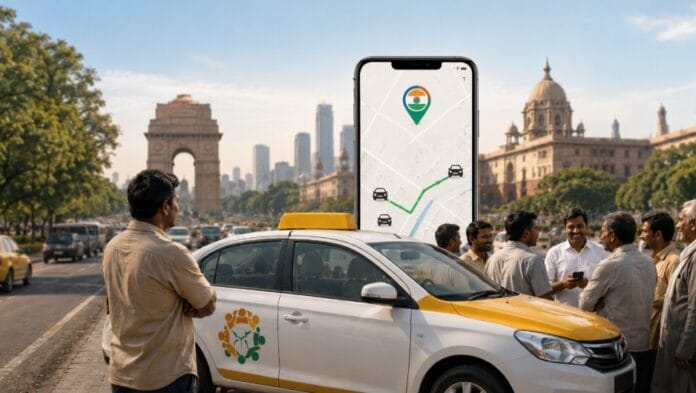
August 13, 2026: India already has a crowded market for app based taxi services. Bharat Taxi is entering the market with a different proposition: building its platform around a cooperative structure and giving drivers a greater role in the business.
Bharat Taxi, operated by Sahakar Taxi Cooperative Limited, has officially launched services across Delhi NCR, Gujarat, Maharashtra and Rajasthan, with a phased expansion planned across other states.
The platform had registered 8.48 lakh drivers and 44.27 lakh customers as of August 4, according to government data. It was facilitating 11,106 rides a day and had enabled cumulative driver earnings of ₹83.70 crore.
These numbers show the scale of registrations. The more important numbers will emerge as the platform grows.
How many drivers are regularly active? How much does a driver earn after fuel, maintenance and other costs? How frequently do customers return? And what makes passengers choose Bharat Taxi over the platforms already available in the market?
The answers could determine whether Bharat Taxi becomes another taxi booking app or develops into a meaningful alternative to the existing platform economy.
The cooperative structure is central to Bharat Taxi’s proposition.
Sahakar Taxi Cooperative Limited is a multistate cooperative society operating Bharat Taxi under the Multi State Cooperative Societies Act, 2002. The model gives the platform an opportunity to build its relationship with drivers around membership, welfare and participation.
For drivers, this could become the most important differentiator.
The taxi business has traditionally placed drivers at the centre of the service, while much of the digital relationship with customers sits with the platform. Bharat Taxi is attempting to bring drivers closer to the ownership and governance side of that relationship.
Whether this creates better economics for drivers will be the real test. The passenger side of the equation is equally important. Customers will judge Bharat Taxi on familiar measures such as availability, fares, response time, safety, reliability and the overall booking experience.
A cooperative structure can create a strong proposition, but customers ultimately choose the service that works best for them.
Bharat Taxi Wants to Change Who Owns the Ride-Hailing Platform
There is also a larger policy question at play.
India has spent years building digital platforms that connect consumers with service providers. Bharat Taxi brings a different institutional model into that ecosystem. If it succeeds, its significance could extend beyond taxis.
It could offer a practical example of how cooperatives can participate in digital markets where technology, capital and customer access have traditionally been controlled by private platforms.
The early figures also show the gap between registrations and actual usage. With 44.27 lakh customers and 8.48 lakh registered drivers, Bharat Taxi was recording 11,106 rides a day as of August 4.
That makes the next phase particularly important. The platform will have to convert registrations into regular activity, build customer habits and demonstrate that drivers can earn well within the cooperative model.
Its expansion across cities will bring another set of challenges. Mobility is deeply local, with driver availability, fares, traffic conditions, regulations and customer behaviour varying from one city to another.
Bharat Taxi has already begun working with West Bengal through an agreement with the state government on July 19. Under the arrangement, Bharat Taxi will support driver enrolment, cooperative membership, driver welfare and public outreach for the Yatri Sathi platform.
For India’s startup and technology ecosystem, Bharat Taxi is worth watching for a simple reason.
The interesting question is less about whether India needs another taxi app. The bigger question is whether a cooperative can build a competitive digital platform at national scale.
If Bharat Taxi can combine the convenience of a modern mobility platform with stronger economics and greater participation for drivers, it could become a significant experiment in India’s platform economy.
The next milestone will therefore be less about the number of people who sign up and more about the number of people who keep using it.

