

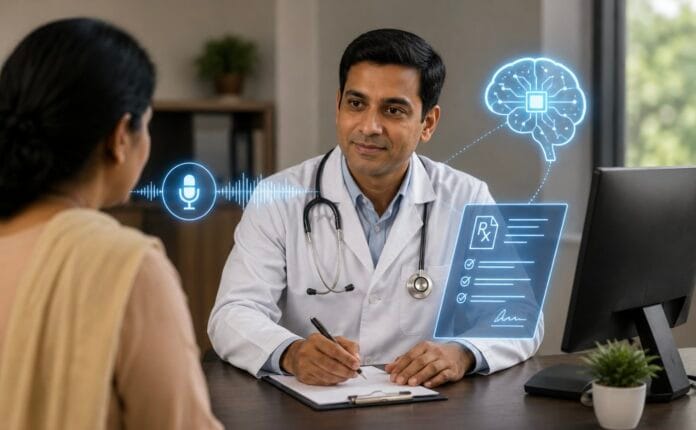
CHENNAI: Plenome, an IIT Madras startup is trying to take that burden off doctors by turning the conversation between a doctor and patient into a medical record and prescription. It is set to solve India’s government hospitals problem, where doctors can see hundreds of patients in a day, the time spent documenting consultations can be almost as demanding as the consultation itself.
Plenome’s Ashwin AI, an AI-powered healthcare documentation platform, listens to consultations, converts speech into text and uses the conversation to generate medical records and prescriptions. The system is designed to also support follow-ups and track patient outcomes.
The technology recently won the national AI hackathon conducted under BHASHINI’s multilingual healthcare challenge, earning ₹35 lakh to pilot the solution. It has also completed three stages of evaluation over the past year and has been deployed at AIIMS New Delhi.
For government hospitals, the proposition is straightforward: reduce the amount of time doctors spend writing notes and give them more time with patients.
Plenome’s Ashwin AI Wins National Hackathon, Eyes Government Hospital Rollout
“Doctors at government hospitals struggle to take notes or do follow-ups due to the high volume of patients,” said Prabhu Rajagopal, director (in charge), IIT-M Zanzibar campus and founder of Plenome. He said the platform can generate prescriptions, communicate medicines to patients and help doctors track health outcomes and recovery.
The bigger challenge for an Indian healthcare AI system, however, is language.
The healthcare documentation platform has been developed to handle conversations across Indian languages, including Hindi, Tamil, Telugu and Gujarati. Plenome says its medical language models have been trained to recognise medical terminology and can achieve 90%-95% accuracy in generating text.
“The latency is 10 seconds to 12 seconds,” said Anirudh Varna, chief technology officer, Plenome. Within that time, the platform can convert the consultation into audio files and generate medical records, he said.
The healthcare documentation platform developer is now looking to work with state governments, including Tamil Nadu and Goa, to take the technology into government hospitals.
The company says the healthcare documentation platform has already generated more than 45,000 AI-assisted prescriptions. Apart from AIIMS New Delhi, the technology is being deployed by Apollo Telehealth and at four NIC-supported hospitals across the country.
Its architecture is also aimed at addressing one of the biggest constraints in healthcare AI, access to large, centralised datasets. Ashwin AI uses a decentralised machine-learning approach, allowing models to be trained across multiple independent data sources without requiring extensive transfer of data.
Plenome is positioning the technology beyond healthcare as well. The same AI platform is being used in areas such as energy metering, parole management and voice-based survey reporting.
The more immediate test, however, will be whether Ashwin AI can move from successful pilots to routine use across India’s public healthcare system, where language diversity, patient volumes and the need for reliable medical documentation make automation considerably harder than simply converting speech to text.

