

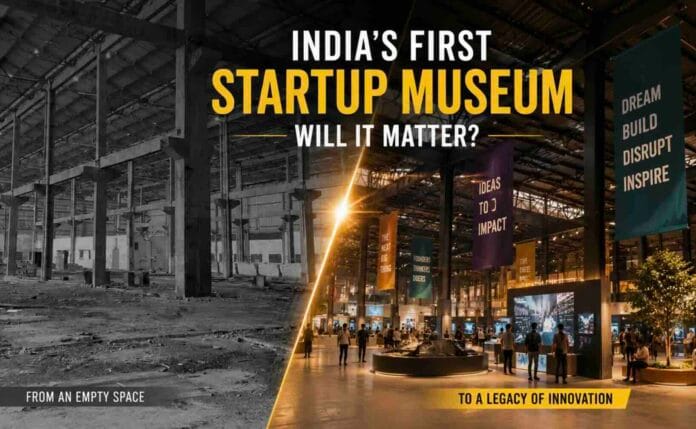
July 27, 2026: Bengaluru has no shortage of startup stories, but a startup museum?. Every year, the city celebrates new unicorns, breakthrough technologies and ambitious founders chasing global markets. But this week, Karnataka announced something different, something that isn’t another accelerator, funding scheme or innovation park.
The state has unveiled plans for India’s first Museum of Innovation, Startup & Technology (MIST), a ₹300-crore project to be developed under a public-private partnership (PPP) model in Bengaluru. The museum will celebrate India’s journey in innovation, entrepreneurship and technology while creating an interactive space that showcases ideas shaping the future.
At first glance, a startup museum may sound unusual. Startups are built around speed. Museums are often associated with history. Yet that contrast is exactly what makes this announcement interesting.
India’s startup ecosystem has spent the past decade building companies. Perhaps the next decade is about preserving the stories behind them, not as trophies, but as lessons.
Every successful startup leaves behind more than a product. There are failed prototypes, difficult pivots, funding rejections, bold decisions and unexpected breakthroughs. Those stories rarely find a permanent home. Most disappear into conference talks, podcasts or social media posts.
Startup Museum : The Real Question What Happens Inside.
A startup museum changes that. If designed well, MIST could become less about displaying gadgets and more about documenting how ideas evolve into companies that shape industries. Imagine students walking through the journey of India’s digital payments revolution, the rise of SaaS, space-tech, semiconductor design, deep-tech, artificial intelligence and climate innovation, not through textbooks, but through immersive experiences.
That could be far more valuable than simply exhibiting old hardware behind glass.
The project also reflects a broader shift in how innovation ecosystems are evolving. Cities such as San Francisco, Boston and Shenzhen are known not just for the companies they produce but for the institutions that preserve and celebrate their innovation culture. Bengaluru has long been India’s startup capital. A dedicated museum gives the ecosystem something it has never had before, a place to tell its own story.
The MIST is expected to come up at the historic NGEF campus in Baiyappanahalli and will be developed by the Karnataka Technology Innovation Museum Foundation under a public-private partnership. Beyond exhibitions, the larger vision includes creating spaces that connect innovation, entrepreneurship and public engagement.
Of course, the success of the startup museum project won’t be measured by its architecture or investment alone.
The real question is whether founders, researchers, students and innovators see it as a place to return to, not once, but repeatedly. If it becomes another static museum filled with timelines and display panels, its impact may be limited.
But if it evolves into a living space where school students build robots, founders share lessons from failure, researchers demonstrate emerging technologies, and startups showcase products before they reach the market, it could become something much larger than a museum.
It could become India’s innovation classroom. Perhaps that is the most exciting part of this announcement.
The startups that will one day occupy these galleries may not even exist today. Somewhere in a classroom, college hostel or garage, the founders of India’s next breakthrough company are probably sketching their first idea.
A startup museum cannot build a startup. But it can inspire someone to build one.

