

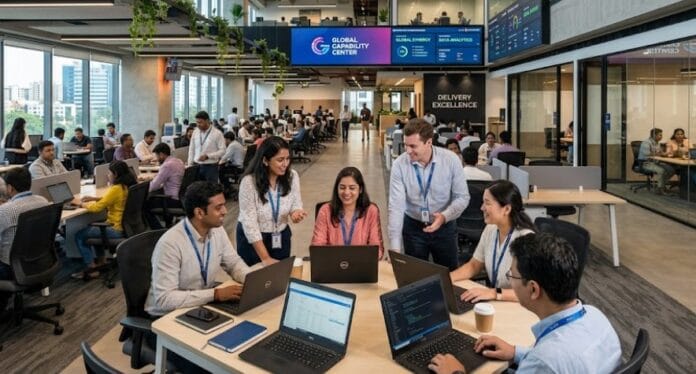
Monday, April 20, 2026: The hiring landscape in India’s Global Capability Centres (GCCs) experienced a significant recovery in the fourth quarter (January-March) of FY26, according to a recent report by staffing solutions provider Quess Corp. Following a more cautious approach in the third quarter, GCCs are now embracing a broader expansion model, with a noticeable shift towards replacing roles rather than purely focusing on new hires.
GCC Hiring Surge: 12-14% Growth in Q4 FY26
Quess Corp’s “India’s GCC Tech Talent Landscape Q4 FY26” report reveals that the sector saw a 12-14% growth in hiring quarter-on-quarter (QoQ), marking a substantial rebound from the 4-6% growth observed in Q3. This uptick signals a shift in strategy, from selective optimization to a recovery-led expansion that is likely to continue into the new fiscal year.
According to the report, 40% of all recruitment activities were related to replacement hiring, reflecting a structural shift in the market driven by the evolving tenure expectations of Gen Z employees, which have now dipped to under 24 months. This shortening of tenure cycles is forcing companies to balance the demands of rapid expansion with the need for stability and continuity in their workforce.
Replacement Hiring Dominates GCC Recruitment
Kapil Joshi, CEO of IT Staffing, pointed out that the hiring trends indicate a broader structural shift within GCCs. “A higher volume of recruitment is being diverted to replacement roles as tenure cycles shorten. This is prompting organisations to rethink how they build depth in their talent pools,” he remarked.
This development suggests that hiring is no longer just about filling new positions, but also managing the higher churn rate within the talent pool. As global hubs, GCCs must now focus on ensuring long-term sustainability and capability building to support their continued growth.
AI, Data, and Platform Engineering Skills in High Demand
While hiring volumes have rebounded, GCCs continue to face significant challenges in sourcing specialized talent. The demand for professionals with skills in Artificial Intelligence (AI), data, platform engineering, and cloud infrastructure is particularly acute.
The report highlighted that the banking, financial services, and insurance (BFSI) sector is experiencing a 42% skill gap in AI and data roles, forcing companies to offer premium salaries: 1.5x to 2.5x higher than typical salaries, to attract the right talent.
Other sectors are similarly struggling with talent shortages. The report revealed 38-42% shortages in AI and data roles, 32-36% in platform engineering, and 28-32% in cloud infrastructure positions. These gaps reflect the growing demand for cutting-edge capabilities as companies modernize their tech stacks and embrace AI-driven transformation.
Tier I Cities Dominate, But Tier II Gains Ground
Tier I cities remain the primary focus for GCC hiring, accounting for 88-90% of all recruitment. Bengaluru and Hyderabad continue to lead this charge, serving as the key hubs for innovation and technical expertise.
However, Tier II cities are beginning to see increased hiring activity, growing their share to 10-12%. Despite this rise, nearly half of all complex technical mandates still remain concentrated in Tier I hubs, reinforcing the hub-and-spoke model, where larger cities focus on innovation and higher-level strategic functions, while smaller cities handle operational scale and execution.
Contractual Roles Rise
A notable trend in Q4 FY26 was the increased reliance on contractual roles, which accounted for 25% of total hiring. This reflects the growing need for flexible staffing solutions, particularly in the context of AI-driven projects and platform-led transformation programs. By leveraging these models, GCCs can quickly access niche skills and manage project-based hiring surges, enabling them to stay agile in a competitive and fast-evolving market.
Key Takeaways
The recovery in GCC hiring signals a shift toward a more dynamic and adaptive workforce strategy. The growth in replacement hiring and the continuing demand for AI and platform engineering talent suggest that GCCs are increasingly prioritizing long-term organizational stability while simultaneously scaling up to meet the challenges of digital transformation.
As India’s role as a global tech hub strengthens, its GCC ecosystem will likely continue to evolve in response to the fast-paced changes in both technology and talent.

