
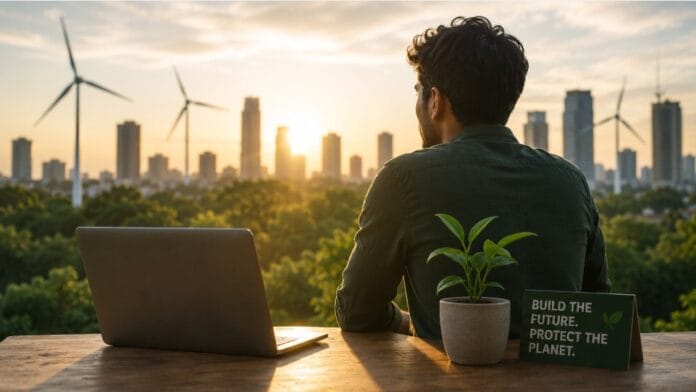
Friday, June 5, 2026: As the world marks World Environment Day 2026, the conversation can no longer be limited to governments, climate conferences, and policy announcements.
The responsibility now sits equally with businesses, entrepreneurs, investors, and startup founders.
India’s startup ecosystem has demonstrated its ability to solve large-scale problems. It has transformed payments, commerce, logistics, healthcare, education, and mobility for hundreds of millions of people.
The next challenge may be even bigger.
Can India’s startup ecosystem help protect the environment that future generations will inherit?
Prime Minister Narendra Modi‘s message on World Environment Day captures the urgency of the moment:
“Guided by the principle of One Earth, One Family and One Future, we will continue working towards a cleaner, greener and more sustainable planet through the spirit of Mission LiFE.”
Those words are more than a slogan. They are a business opportunity, a social responsibility, and perhaps the defining innovation challenge of this decade.
World Environment Day 2026: The Future Needs Green Startups, Not Just Fast-Growing Ones
For years, startups have been measured by revenue growth, funding rounds, and valuations.
The next era may demand a new metric.
How much waste was reduced?
How much energy was saved?
How much water was conserved?
How many tonnes of carbon emissions were avoided?
The startups that answer these questions on world environment day 2026 successfully will not only create economic value but societal value.
What Startups Can Do Today
The environmental movement does not always begin with billion-dollar technologies.
It begins with everyday decisions.
A logistics startup can optimize routes and reduce fuel consumption.
An e-commerce company can eliminate unnecessary packaging.
A food delivery platform can reduce single-use plastics.
A manufacturing startup can adopt renewable energy.
A SaaS company can track and disclose its carbon footprint.
An investor can prioritize sustainability alongside profitability.
On World Environment Day 2026, small actions multiplied across thousands of startups can create an impact larger than any single campaign.
The Real Legacy We Leave Behind
The greatest risk facing future generations is not a lack of innovation.
It is innovation without responsibility.
The children who will lead India in 2050 will not remember today’s funding announcements or valuation milestones.
They will live with the consequences of today’s environmental decisions.
The air they breathe.
The water they drink.
The forests that survive.
The climate they inherit.
Those outcomes are being shaped right now.
A Defining Moment for India’s Startup Ecosystem
India is home to one of the world’s fastest-growing innovation economies.
That leadership now comes with a larger responsibility.
The question is no longer whether startups can build the future.
The question is what kind of future they are building.
A cleaner future.
A healthier future.
A more sustainable future.
Or one that simply moves faster without considering the cost.
On World Environment Day 2026, perhaps the most important startup ambition is not becoming the next unicorn.
It is ensuring that the next generation inherits a planet worth living on.
Because the most valuable company of the future may be the one that leaves the smallest environmental footprint.

