

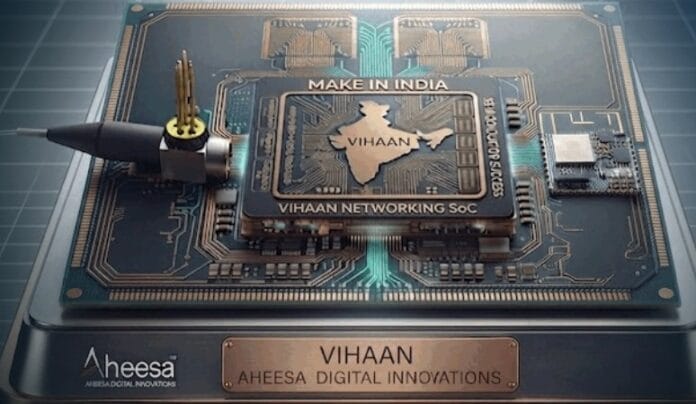
August 18, 2026: India’s semiconductor startup ambitions are increasingly moving into a phase where chip designs developed by domestic companies are reaching fabrication, validation and eventual commercial deployment. Chennai based fabless semiconductor startup Aheesa Digital Innovations is the latest company to mark that progress with its VIHAAN networking System on Chip (SoC), designed for fibre broadband applications.
Aheesa taped out VIHAAN on Republic Day and achieved first pass silicon success on Independence Day this year, a milestone that moves the chip towards production tape out targeted for 2027.
The development comes as India expands optical fibre networks, 5G infrastructure and broadband services, creating demand for networking silicon capable of supporting the country’s growing digital infrastructure. Aheesa is developing VIHAAN specifically for fibre broadband, positioning the chip around a market where connectivity requirements are expanding across consumer, enterprise and infrastructure applications.
Semiconductor design has become an increasingly important part of India’s broader electronics and semiconductor strategy. Chip design can contribute up to half of the value created across the semiconductor value chain, while accounting for roughly 15% to 35% of the Bill of Materials cost of electronic products.
The government’s Design Linked Incentive (DLI) Scheme has emerged as a key mechanism supporting Indian startups developing semiconductor designs for applications ranging from telecommunications and automotive systems to drones, surveillance, defence, aerospace, IoT devices and smart meters.
For Aheesa, the government support has been accompanied by private capital. The company raised around ₹40 crore earlier this year from the Tamil Nadu Infrastructure Fund Management Corporation through the Tamil Nadu Emerging Sector Seed Fund, along with other private investors. The funding is being used to accelerate product development and expand the company’s semiconductor operations.
Aheesa’s VIHAAN chip moves India’s semiconductor design push closer to production
The funding also points to a wider shift in investor interest towards Indian semiconductor companies that can take designs beyond the development stage and towards validated silicon and commercial products.
Across the DLI supported ecosystem, companies have cumulatively completed more than 30 chip design tape outs across different foundries and raised more than $100 million in venture capital funding. The figures indicate a growing pipeline of Indian semiconductor startups progressing from design concepts towards physical chips.
The government’s Chips to Startup programme is also expanding the talent pipeline, with 245 chip designs taped out by 71 academic institutions. Chip design tools have meanwhile been made available to 455 organisations, including 350 academic institutions and 105 startups.
Several other Indian semiconductor companies have recently recorded milestones across different applications.
Vervesemi Microelectronics has achieved first pass silicon success for a BLDC motor controller chip built around an indigenous microprocessor from InCore Semiconductor and its motor driver chip. Netrasemi has successfully tested its 12nm Vision SoC with integrated video analytics acceleration, while OptoML has received its 12nm compute in memory SoC designed to improve processing performance and power efficiency.
Mindgrove Technologies has also partnered with PRAMA India to explore the use of its Vision SoC in CCTV surveillance cameras, while IndieSemiC has secured global certification for its Bluetooth Low Energy 6 chip module.
Together, these developments point towards a semiconductor design ecosystem that is widening across networking, industrial electronics, vision systems, connectivity and automotive applications.
The larger policy push is also moving beyond individual chip designs. India’s semiconductor programmes are aimed at developing capabilities across design, fabrication, advanced packaging, equipment, materials, research and development and skilled manpower.
With Semicon 2.0 approved in July 2026 with an outlay of ₹1,27,500 crore, the government is seeking to build a globally competitive semiconductor ecosystem with greater domestic capabilities across the value chain.
For startups such as Aheesa, the next milestone will be taking validated silicon towards production and customer deployment. VIHAAN’s planned production tape out in 2027 will therefore provide a more significant test of the company’s ability to translate semiconductor design expertise into a commercial product.
That transition matters for India’s semiconductor ambitions. Designing a chip establishes technical capability; fabricating, validating and deploying it at scale creates a business.
Aheesa’s progress, alongside milestones from other DLI supported companies, suggests that India’s semiconductor startup ecosystem is gradually moving towards that second stage, where locally designed silicon can compete for applications in India and potentially serve global markets.

