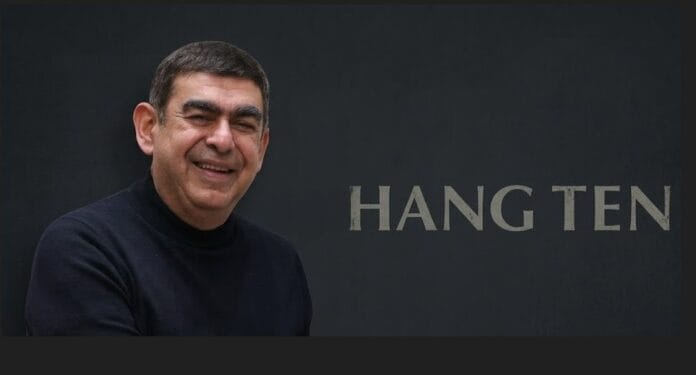
September 17, 2026: Four months after launching, Hang Ten is already moving at a pace that most early-stage startups take years to reach. The AI company founded by former Infosys CEO Vishal Sikka has secured another $53 million, taking its total funding to $85 million and giving it fresh capital to expand its push into enterprise software.
The latest financing follows the company’s initial $32 million seed round by just five weeks. More importantly, the rapid fundraising comes as Hang Ten says it is converting interest from large corporations into multimillion-dollar software contracts.
The startup is targeting companies with annual revenues typically exceeding $10 billion, offering them a combination of AI strategy, software development and modernization services. Its pitch is built around a simple shift in enterprise technology: as AI makes software development faster and less expensive, companies will increasingly need help defining what they want built and ensuring the resulting systems work reliably.
That proposition appears to be gaining traction. Sikka said one customer signed a multimillion-dollar agreement with Hang Ten just 25 days after the company’s first meeting with the organization, a turnaround he described as unusually fast for an enterprise software deal.
Hang Ten now has 21 major enterprises either working with the company or in advanced discussions, Sikka said. Some prospects are at the proposal or contract-negotiation stage, while the startup has already secured several seven-figure contracts and is pursuing deals that could reach eight figures.
Its customers and prospects span the U.S., Europe, the Middle East and Asia. Hang Ten has publicly identified Fresenius Kabi, Saudi Aramco and Siemens Energy among its customers.
The company’s strategy does not involve developing another foundational AI model. Instead, Hang Ten is trying to apply existing AI technology to the difficult, highly customized software environments found inside large corporations.
Co-founder and chief design officer Sanjay Rajagopalan said the company’s engineers use an internal framework called Hobie, which brings together reusable AI capabilities for regulated industries and complex enterprise software projects. The company says its focus is on taking AI-assisted development into production rather than stopping at experimental projects or proof-of-concept demonstrations.
That approach places Hang Ten alongside both established systems integrators and a growing group of AI companies targeting enterprise customers. OpenAI and Anthropic are expanding their business offerings, while traditional consulting and technology-services companies are incorporating generative AI into their existing operations.
Sikka believes there remains a role for an independent technology company that can work with enterprises regardless of which underlying AI platform they choose. He argues that large organizations still need partners focused primarily on their business requirements rather than the interests of a particular AI model provider.
Hang Ten is also positioning itself around the economics of AI-assisted software development. Rajagopalan said certain projects can be handled by teams of two to four people that might previously have required around 30. Customers or independent parties still conduct final quality checks and certification, while Hang Ten is targeting a tenfold improvement in project cost, speed or a combination of the two.
The startup plans to use its latest funding to expand its engineering, consulting and sales teams. It currently has around 20 to 25 employees across the U.S., the Middle East and Australia, with plans to recruit in Europe and India.
Hang Ten has also attracted acquisition interest despite its short operating history. Sikka said several large companies have approached the startup about a potential acquisition, but he declined to identify them. The company has chosen to remain independent for now as it concentrates on expanding its business.
Before Hang Ten, Sikka co-founded enterprise AI company VianAI in 2019 after leaving Infosys in 2017. VianAI raised $50 million in seed funding and later secured $140 million in a 2021 financing led by SoftBank Vision Fund 2. Sikka left the company in April, according to his LinkedIn profile, and has said VianAI is currently going through a transaction without providing further details.
Hang Ten’s latest funding was led by Xora, Temasek’s early-stage investment platform. Mayfield, which led the startup’s earlier $32 million financing, also participated. Other investors in the round include Aramco Ventures, Intel CEO Lip-Bu Tan, Micron CEO Sanjay Mehrotra and Yahoo co-founder Jerry Yang, who also serves on Hang Ten’s board.
The startup’s name is drawn from surfing, where “hang ten” describes a maneuver in which a surfer places all ten toes over the front of the board. For Sikka, the name reflects the company’s ambition to help large businesses keep pace with what he sees as a major new wave of AI-driven change.
This opening gives the story a business-development angle first, then gradually moves into funding, customers, competition and finally the investor details, so it reads less like a funding announcement and more like a reported technology-business story.

