

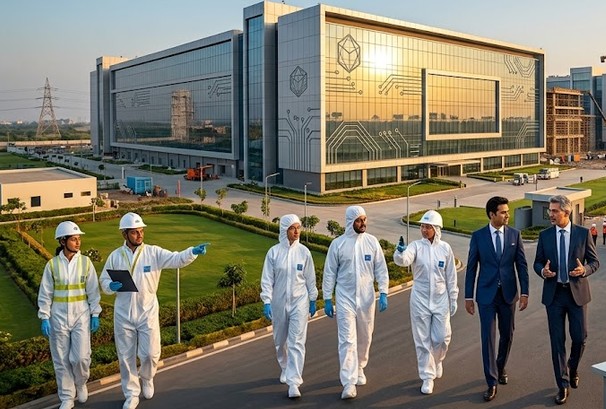
October 13, 2026: India is rapidly morphing from a global back-office design hub into a formidable front-runner in silicon innovation. A sharp rise in buyouts, late-stage funding, and corporate buy-in is reshaping the nation’s hardware narrative. This push is placing homegrown deep-tech firms squarely at the center of the global artificial intelligence infrastructure race.
Data compiled from government registries and industry tracking tools points to a dramatic shift in how global risk capital treats local chip ventures.
When New Delhi announced its massive financial backing initiative in late 2021, early-stage funding sat at a modest footprint, drawing just $25.1 million. Today, that trickling interest has turned into a major capital flow.
Early venture activity quickly blossomed, culminating in a historic high during 2025 when startup investments crossed $474 million.
Late-stage funding led that charge, rising dramatically within a two-year span to hit $361 million. This momentum shows no sign of cooling, with funding tallies passing $228 million in the first nine months of this year alone.
The influx of capital mirrors an expanding roster of backers willing to write checks for high-risk, long-gestation hardware ideas in the semiconductor sector. The number of new institutional investors taking bets on local silicon innovators expanded dramatically, jumping from 12 in 2021 to 80 in 2024.
Institutional players point directly to the country’s human capital as the core catalyst.
With roughly 20 percent of the world’s semiconductor design workforce operating out of Indian engineering centers, venture firms like Peak XV Partners are aggressively backing homegrown founding teams. Their portfolio includes ventures such as Agrani Labs, C2i Semiconductors, InCore Semiconductors, and Mindgrove.
This deep engineering pool is also sparking a wave of strategic buyouts. Seven consolidation deals have already landed this year, reflecting a structural revaluation of domestic firms.
Across 3,557 companies in the semiconductor and allied sectors, 68 were acquired at a median price of $33.7 million over recent years.
Global Capital Backs India Silicon Ventures as M&A Touches $125M
Recent strategic buyouts, however, tell a different story. Median deal values have climbed sharply to $125 million as international majors move quickly to acquire specialized intellectual property.
Cross-border buyouts illustrate this shifting focus toward high-value infrastructure applications.
Notable earlier transactions, like Standex acquiring Vadodara based Narayan Powertech for $261.9 million in 2024 and Renesas acquiring Bengaluru based radar solution provider Steradian for nearly $36 million in 2022, set the stage for deeper integration.
More recently, in August 2026, German chipmaker Infineon acquired C2i Semiconductors. The Bengaluru outfit specializes in software-defined multiphase controllers and smart power stages tailor-made for artificial intelligence data centers.
The move underscores how domestic teams are directly solving complex power efficiency challenges for modern computing clusters.
Industry insiders note that the investment scope is broadening beyond core logic and memory design.
Mergers and strategic acquisitions now encompass vital secondary layer operations, including power optimization for silicon chips and industrial water recycling systems required for manufacturing hubs.
Supported by expanding state incentives and major domestic manufacturing milestones in industrial hubs like Dholera and Sanand in Gujarat, seasoned talent with international domain expertise is consistently launching deep-tech ventures.
Rather than simply offering outsourced design services, Indian founders are now building, owning, and scaling proprietary technology stack assets for global markets.

