

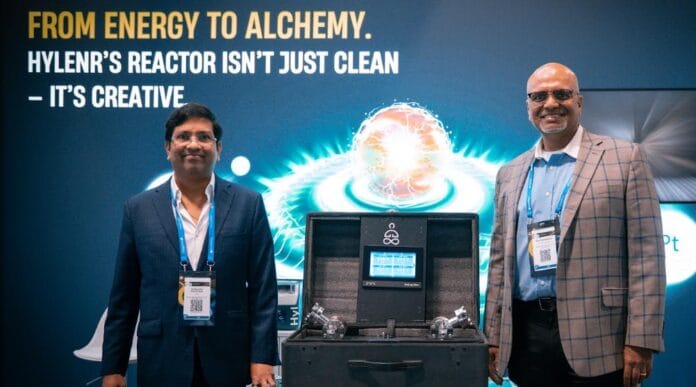
Hyderabad, September 22, 2026: A Hyderabad deep-tech startup working on an unconventional approach to fusion energy says an independent study at Texas A&M University has produced a set of thermal, gas-analysis and materials observations that will now be subjected to further testing. The results, will advance the underlying mechanism, to proving a commercially viable fusion reaction, and gives Hylenr an external experimental dataset as it moves toward a second phase of validation.
Hylenr said it has completed Phase 1 of an independent validation study of its Lattice Confinement Fusion (LCF) technology, carried out in the Nuclear Engineering Department at Texas A&M University. The work examined the company’s BRT-NiUCS-2 reactor, a small modular device that uses hydrogen-loaded nickel-palladium catalyst materials.
The study is notable because the experiments went beyond a single measurement. Researchers looked at the reactor’s thermal behaviour, residual gases, radiation signals and the physical and chemical characteristics of catalyst samples after testing.
The Phase 1 paper, titled “Validation of Anomalous Heat and Nuclear Signatures in the BRT-NiUCS-2 Reactor: Phase 1 LCF Investigation,” was co-authored by Hylenr and Texas A&M researchers and presented at the 27th International Conference on Condensed Matter Nuclear Science (ICCF-27) in Niagara Falls, Canada, held from August 31 to September 4.
One of the more intriguing observations came from Residual Gas Analysis (RGA), a technique used to identify and measure gases inside a vacuum system.
Using an SRS RGA 100 system under high-vacuum conditions, researchers reported elevated signals for helium, argon and neon in the active reactor compared with background measurements. The reported helium and argon signals were approximately two to three orders of magnitude above background.
The researchers also reported that nitrogen did not show a corresponding increase.
That detail matters experimentally. Atmospheric contamination would normally be expected to introduce nitrogen along with other components of air. The absence of a comparable nitrogen increase therefore gives the researchers a reason to investigate sources other than simple air leakage — although it does not, by itself, establish a nuclear origin for the gases.
For a technology making claims around nuclear phenomena, distinguishing genuine reaction products from contamination, outgassing or measurement artefacts is one of the central challenges of validation.
The study also reported a thermal difference between the active reactor and a calibration device operated under comparable input-power conditions.
Thermocouples and calibrated infrared imaging were used to monitor temperature. According to the Phase 1 findings, the active BRT-NiUCS-2 reactor consistently reached higher temperatures than the calibration device.
The observation is important to the company’s research programme because excess heat, heat that cannot be accounted for by the electrical energy supplied to a system ,is one of the measurements that researchers would need to quantify carefully before drawing conclusions about the source of the energy.
Hylenr said future experiments will therefore place greater emphasis on quantitative calorimetry, designed to establish the amount of energy entering and leaving the reactor with greater precision.
The radiation measurements add another layer to the results. Researchers monitored the reactor using Geiger–Müller and neutron detectors during approximately five days of testing. The study reported no detectable gamma or X-ray emissions, while neutron counts remained statistically indistinguishable from background.
That finding does not settle the question of whether nuclear processes are occurring. Rather, it defines an important experimental constraint for the next stage of the work: any proposed mechanism must be consistent with the radiation measurements recorded under the conditions tested.
Researchers also examined catalyst samples after the experiments using scanning electron microscopy and energy-dispersive X-ray spectroscopy (SEM/EDX).
The analysis reported changes in the morphology and elemental composition of the catalyst materials following reactor operation. Such changes can provide clues about what happens to materials inside the reactor, but determining whether they are caused by the proposed reaction, hydrogen loading, heating or other processes requires controlled comparisons and additional analysis.
Hylenr Fusion Study Reveals Helium Signals Without Radiation Spikes
That is one reason Hylenr’s next phase is expected to expand the number of reactors and measurements rather than rely on a single experimental configuration.
From unusual observations to reproducibility
Ram Ramaseshan, co-founder and board member of Hylenr, said the objective of the Texas A&M work was to move the company’s observations beyond internal testing.
“Our objective has always been to move beyond internal observations and subject the technology to rigorous, independent testing.”
According to Ramaseshan, the Texas A&M study provides an external dataset spanning thermal measurements, gas analysis and materials characterization, while the next stage will focus on reproducibility and quantitative measurement.
Prof. Lin Shao, professor of nuclear engineering at Texas A&M University, said the Phase 1 programme combined several analytical techniques to examine the BRT-NiUCS-2 reactor and identify priorities for further investigation.
The significance of that approach lies in the cross-checking. A temperature anomaly, for example, becomes more scientifically informative when researchers can simultaneously examine gas composition, radiation measurements and changes in the reactor materials.
Hylenr now plans to move into Phase 2 of the validation programme.
The company said the next stage will involve multiple independent reactors, quantitative calorimetry and improved control and characterization of hydrogen-loading parameters. Researchers also plan to conduct isotopic-ratio measurements and use techniques including secondary ion mass spectrometry (SIMS) and inductively coupled plasma mass spectrometry (ICP-MS).
Those measurements could be particularly important for determining whether the observed helium and other signals are associated with changes in isotopic composition or have more conventional explanations.
The broader scientific challenge is straightforward but demanding: Can the observations be reproduced, measured quantitatively and explained by a mechanism that survives independent testing?
For Lattice Confinement Fusion, those questions are more consequential than any individual temperature reading or gas signal.
Hylenr says its longer-term objective is to develop a scalable energy system while also exploring applications in strategic rare-earth production. The company describes the current validation programme as a bridge between laboratory observations and commercial engineering.
For now, the Texas A&M study represents a first external checkpoint. The next phase will determine whether the signals reported in Phase 1 can be reproduced across multiple systems and whether their origin can be established with greater experimental certainty.

