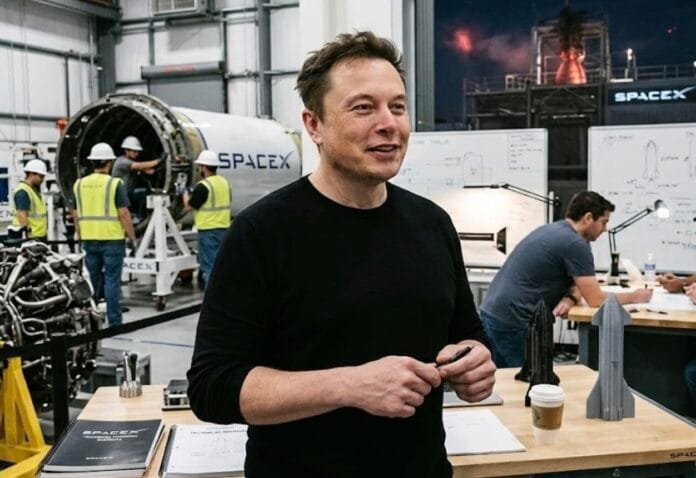
Wednesday, April 22, 2026: Deepening ambitions beyond aerospace, Elon Musk’s SpaceX has entered into a strategic agreement with AI coding startup Cursor to co-develop a next-generation artificial intelligence system for software development and knowledge work. The deal includes a striking clause: an option for SpaceX to acquire Cursor for $60 billion later this year.
The partnership arrives at a pivotal moment as SpaceX prepares for a widely anticipated public offering. Market watchers see the collaboration as a calculated step to boost investor appeal by expanding the company’s footprint in one of the fastest-growing segments of the tech economy, AI-assisted coding.
Under the agreement, Cursor will integrate its developer-focused tools and distribution network with SpaceX’s high-performance computing infrastructure, including the Colossus supercomputer. The system, developed by xAI, is claimed to deliver compute power equivalent to one million Nvidia H100 chips, positioning it among the most powerful AI training clusters globally.
The relationship between the companies has been building in recent months. Cursor has already begun leveraging xAI’s data center capacity, reportedly deploying tens of thousands of chips to train its latest models. Meanwhile, key engineering leaders from Cursor, including Andrew Milich and Jason Ginsberg—have transitioned to xAI, underscoring tighter operational alignment across Musk’s expanding ecosystem.
Musk’s SpaceX Doubles Down on AI with High-Stakes Cursor Partnership

Financially, the agreement presents two possible outcomes: SpaceX may either pay Cursor $10 billion for its contributions or proceed with a full acquisition at $60 billion. Either route represents a substantial commitment, particularly as SpaceX continues to invest heavily in AI infrastructure and absorb costs tied to its broader portfolio, including X and xAI.
Cursor’s valuation trajectory highlights the rapid ascent of AI coding platforms. From $2.5 billion early last year, the company’s valuation surged to nearly $30 billion by late-stage funding rounds, with reports suggesting it is now targeting $50 billion in upcoming private financing. A potential $60 billion acquisition would further cement its position among the most valuable AI startups globally.
Strategically, the partnership addresses critical gaps for both sides. Cursor currently relies on third-party models from competitors like OpenAI and Anthropic, even as those firms push into developer tools, creating a competitive tension. Access to SpaceX and xAI infrastructure could help Cursor build more independent capabilities.
For xAI, the deal offers a pathway into the AI coding market, where its Grok chatbot has yet to gain significant traction against established rivals. Integrating Cursor’s product ecosystem could accelerate its relevance among software developers.
The announcement also highlighted SpaceX’s broader transformation into a multi-sector technology conglomerate. Alongside its core space business, the company is investing aggressively in AI, computing infrastructure, and software platforms, moves that could significantly influence its projected $1.75 trillion IPO valuation.
As competition intensifies in the AI space, the SpaceX-Cursor alliance reflects a larger trend: the convergence of compute power, software platforms, and capital at unprecedented scale. Whether the partnership evolves into a full acquisition may ultimately depend on how quickly the combined capabilities translate into market-leading AI products.

