

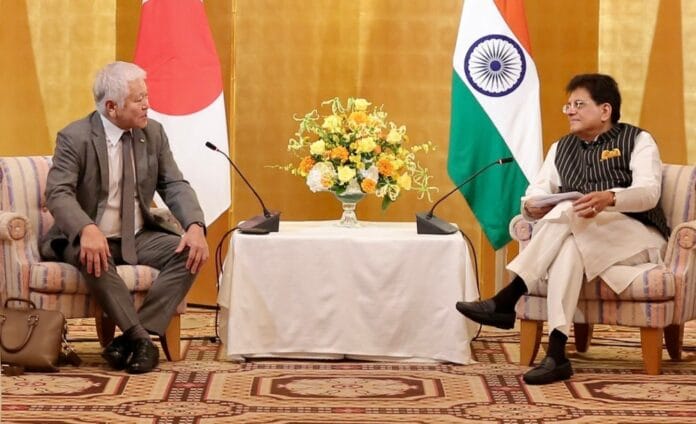
August 27, 2026: India’s startup story is entering a more industrial phase. The spotlight which was largely on consumer internet, fintech, SaaS and digital platforms, while remain important, the next wave of entrepreneurship could be built much closer to factories, supply chains, semiconductor plants, energy systems and advanced technology.
That is what makes Commerce and Industry Minister Piyush Goyal’s latest visit to Japan particularly relevant for Indian entrepreneurs.
Goyal’s Japan visit focused on attracting greater Japanese investment into India, strengthening manufacturing partnerships and building deeper cooperation in areas such as semiconductors, artificial intelligence, clean energy, automobiles, machinery and infrastructure. More than 30 major Japanese companies and financial institutions participated in discussions, while a separate roadshow in Nagoya brought together more than 80 companies from the Chubu region.
The headline target is significant: India is seeking JPY 10 trillion in Japanese private investment over the next decade.
For startups, however, the more interesting question is simply how much money could enter India. And, where that capital could create new businesses.
1. The semiconductor opportunity is bigger than chip manufacturing
India’s semiconductor ambitions are often discussed in terms of fabrication plants and chip assembly. But startups do not necessarily need to build billion-dollar fabs to participate in the opportunity.
Goyal highlighted a six-pillar semiconductor strategy covering chip design, machinery and materials, fabrication, ATMP and OSAT, research and development, and talent development. India’s semiconductor demand is projected to reach $150 billion by 2032.
That creates a much wider opportunity for entrepreneurs. Startups can potentially build businesses around semiconductor testing, specialised equipment, industrial software, materials, clean-room services, chip-design tools, logistics, maintenance, workforce training and supply-chain management.
The lesson for founders is simple: look at the ecosystem around the factory, not just the factory itself. Japanese companies have decades of experience in precision engineering, electronics, machinery and advanced manufacturing. Indian startups can become the bridge between that expertise and the scale of the Indian market.
2. Japan could become a strategic customer, not just an investor
The traditional startup fundraising story is built around venture capital. The India-Japan opportunity points towards something different: strategic partnerships.
A Japanese manufacturing company entering India may need dozens of local suppliers, technology providers, logistics partners, software companies and specialised service providers. For an Indian startup, becoming one of those suppliers could be more valuable than simply raising money from a Japanese investor.
This creates a potentially powerful model. A startup could start by solving a specific operational problem for one Japanese manufacturer, prove the solution in India and then expand it across that company’s wider supplier network.
In other words, the Japanese investment story could produce B2B startups with large industrial customers from day one.
3. Tier-II and Tier-III cities could become startup hotspots
One of the less-discussed aspects of the visit was the emphasis on India’s Tier-II and Tier-III supplier ecosystem and MSMEs. This matters because the next generation of industrial startups may not emerge from the traditional startup centres alone.
As manufacturing expands into new clusters, entrepreneurs located closer to those industrial ecosystems could have an advantage. They understand local suppliers, workforce availability, logistics constraints and the practical problems faced by factories.
Dholera and Sanand, for example, are emerging as important semiconductor locations. Similar industrial clusters could generate demand for startups working in logistics, industrial maintenance, workforce management, energy efficiency, compliance and specialised manufacturing services.
The opportunity is not necessarily to build the next consumer app. It could be to build the company that makes 500 factories operate better.
4. AI is moving from the screen to the factory floor
The India-Japan discussions also covered artificial intelligence alongside semiconductors and advanced technology. That combination is important.
The most interesting industrial AI opportunities may involve predictive maintenance, quality inspection, robotics, warehouse optimisation, production planning, energy management and supply-chain forecasting.
Indian entrepreneurs have an opportunity to combine software talent with Japan’s manufacturing expertise. For example, a startup that helps a factory identify production defects using computer vision may initially look like a small industrial software business. But if the technology works across multiple factories, suppliers and countries, the addressable market changes dramatically.
The bigger opportunity is to make Indian manufacturing more productive while creating technology that can eventually be exported.
5. Clean energy could become industrial infrastructure
Semiconductor fabs, AI infrastructure and data centres have one thing in common: they require enormous amounts of reliable power. Goyal highlighted India’s renewable energy capacity and national power grid as important enablers for energy-intensive industries.
That opens another category of startup opportunities. Entrepreneurs can build businesses around industrial energy optimisation, battery systems, power-quality management, renewable integration, energy monitoring and solutions that help factories reduce operating costs.
The opportunity becomes particularly interesting when Japanese engineering and capital meet Indian startup execution.
A founder does not necessarily need to invent a completely new energy technology. There is considerable room for businesses that make existing technologies cheaper, easier to deploy and more effective for Indian industrial customers.
6. The automotive relationship could create a new supplier generation
Japan’s automotive companies already have a deep presence in India. The latest discussions point towards expanding cooperation across automobiles, auto components, machinery and manufacturing.
For startups, this creates opportunities beyond electric vehicles. Advanced components, industrial robotics, factory software, battery systems, vehicle electronics, precision manufacturing and supply-chain technology could all become areas where startups work alongside established Japanese manufacturers.
The key advantage is that Indian startups can potentially combine the speed of a young company with the quality requirements and global supply chains of Japanese industry. That is a powerful combination if executed well.
7. The biggest opportunity may be the industrial middle layer
There is a tendency to think about investment in terms of large companies at one end and startups at the other. The real opportunity could sit in between.
As Japanese companies expand their Indian operations, they will need a large network of smaller companies capable of meeting international standards. Those businesses can provide specialised components, software, engineering services, logistics, testing, maintenance and other functions.
This “middle layer” could become one of the most important startup opportunities created by the India-Japan relationship. It also changes what entrepreneurs should look for.
Instead of asking, “What consumer problem can I solve?”, founders could ask, “What problem will a global manufacturer face when it scales in India?”
That question can lead to very different businesses.
What Japanese capital could mean for Indian founders
The proposed JPY 10 trillion investment ambition should not be viewed only through the lens of large infrastructure projects or multinational corporations.
Capital can create demand throughout an ecosystem. A new semiconductor facility needs suppliers. A new automobile plant needs components. A data centre needs power and cooling. A manufacturing cluster needs logistics. A technology company needs specialised talent. Every new industrial project creates a chain of smaller problems that someone needs to solve.
Those problems are potential companies. For Indian founders, the India-Japan relationship therefore represents more than an investment story. It could become a route into global industrial markets.
Japanese companies bring engineering depth, manufacturing discipline, technology and long-term business relationships. India brings a large domestic market, engineering talent, digital infrastructure and an expanding startup ecosystem.
The opportunity lies in connecting the two.
The startup opportunity is moving closer to the real economy
India’s startup ecosystem spent much of the last decade building businesses around smartphones, digital payments and internet consumption. The next decade could look different.
Factories, semiconductor clusters, energy infrastructure, automobiles, logistics and advanced technology are becoming increasingly important areas for entrepreneurship. The companies that emerge from this shift may be less visible to consumers but far more deeply embedded in the economy.
The India-Japan partnership could accelerate that transition.
For entrepreneurs, the message is worth paying attention to: the next big startup opportunity may not be another app. It may be the company supplying, powering, automating, financing or connecting the industries that India is trying to build.
And if India succeeds in attracting JPY 10 trillion in Japanese private investment over the next decade, there could be thousands of such opportunities hiding underneath that headline number.

