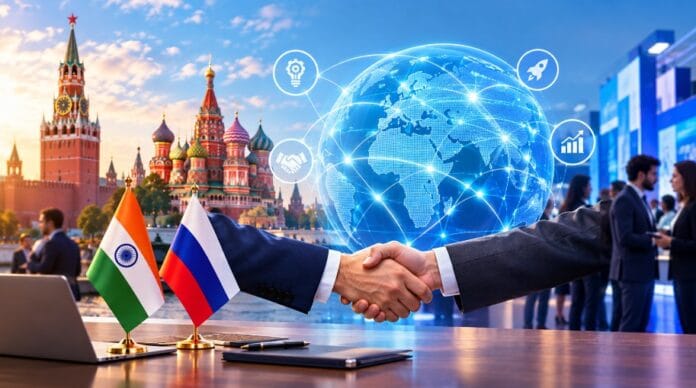
October 2, 2026: The Moscow Startup Summit ended this week with Indian startups leaving behind more than a showcase of products. Their participation pointed to a broader effort to build technology links between India and Russia, with robotics, agriculture and artificial intelligence emerging as some of the areas where the two ecosystems found common ground.
Held over two days at SberCity, the summit brought together startups, investors, corporations and technology experts under an initiative organised by the Moscow government and Sberbank, Russia’s largest bank. The event focused on turning startup technologies into commercial applications across sectors ranging from healthcare and agriculture to education, urban development and robotics.
The Indian presence was particularly notable for the range of problems being addressed at the Moscow Startup Summit 2026.
AB6 Robotics presented a platform designed to make robotics education more hands-on. Instead of separating coding, simulation and physical robotics into different learning environments, the company combines them on a single platform. Learners can write and test code, work with simulations and eventually apply what they have learned to physical robots.
That model reflects a growing demand for practical robotics skills as automation expands beyond industrial settings. The company’s proposition at the summit was therefore not simply about teaching robotics, but about creating an environment in which learners can move from experimentation to real-world applications.
CropGen brought another application of technology to the summit, this time in agriculture. Its platform uses satellite imagery along with weather and soil information to track crop conditions, identify potential disease risks and help determine irrigation requirements.
Moscow Startup summit creates new pathways for Indian startup deals
The company’s presence in India, Thailand and South Africa also gave its proposition a wider relevance. CropGen has designed its service to work through a mobile application as well as WhatsApp and SMS, while supporting nine languages. For farmers in areas where connectivity can be inconsistent, those access points can be as important as the underlying satellite technology.
The Moscow Startup summit‘s conclusion also produced a potentially more concrete example of India-Russia technology cooperation.
Sberbank and CoRover, the Indian company behind the BharatGPT platform, announced plans to integrate GigaDoc, an AI-based health assessment technology developed by SberMedAI, into CoRover.ai in India.
The proposed integration could extend GigaDoc beyond its existing technology demonstration into applications involving population surveys and AI-powered government services. The companies said the first phase would involve 100,000 scans, with the service expected to operate across multiple languages and formats, including voice interaction.
GigaDoc uses a camera to assess health indicators without physical contact. SberMedAI says its system can analyse 17 indicators in around 15 seconds using artificial intelligence, computer vision and remote photoplethysmography. These include heart rate, blood pressure, stress and fatigue levels, body mass index and the risk of Type 2 diabetes.
The technology is not intended to replace medical diagnosis. Any potential abnormality identified through such an assessment would need to be followed up with a doctor and, where appropriate, further medical testing.
What made the CoRover-SberMedAI announcement significant was its focus on deployment rather than demonstration. Bringing a Russian-developed health technology onto an Indian AI platform creates a route for the product to be tested against India’s scale, language diversity and digital-service infrastructure.
The summit also provided an opportunity for Sberbank to underline India’s growing importance in the global technology and venture capital landscape. Alexander Vedyakhin, first deputy chairman of Sberbank’s executive board, highlighted India’s venture capital market and its digital infrastructure as factors supporting technology entrepreneurship.
Taken together, the developments at the summit suggest that the Indian participation was not limited to startups presenting their products to potential investors. The more important outcome was the emergence of specific areas for cooperation, including AI-enabled healthcare, robotics education and data-driven agriculture.
The event has now ended, but the partnerships and technologies discussed there will determine whether the summit produces lasting commercial links. For Indian startups, the Moscow gathering offered access to a different technology ecosystem; for Russian companies and institutions, it provided a closer look at India’s ability to develop and deploy technology at scale.
The real measure of the summit, therefore, will not be the number of startups that appeared on stage, but how many of the conversations and announcements made in Moscow turn into products, deployments and long-term partnerships.

