
May 3, 2026: The Indian startup ecosystem in April 2026 presented a landscape of sharp contrasts: a cooling venture capital environment tempered by a warming IPO market, and a significant regulatory “clean-up” of the fintech sector coinciding with a global workforce restructuring driven by Artificial Intelligence.
A Funding Cool-Down with Strategic Outliers
Indian startup funding experienced a month-on-month decline, falling to $865 million in April from $948 million in March. This post-February cooldown saw a reduction in large-ticket activity, with only one deal exceeding the $100 million mark: KreditBee’s $280 million Series E round.
Despite the overall slowdown, Bengaluru solidified its status as the nation’s tech heart, accounting for a massive 68.08% of total capital raised across 34 deals. While total funding rose year-on-year compared to April 2025, the deal count slipped to 92, down from 121 just two years prior.
The Regulatory Reckoning
April 2026 was defined by a decisive “tightening of the grip” by the Reserve Bank of India (RBI). The most seismic move occurred on April 24, when the RBI cancelled the license of Paytm Payments Bank citing compliance and governance lapses. This action, coupled with proposed one-hour delays for UPI transfers over ₹10,000 and stricter draft guidelines for prepaid instruments, signals a shift toward prioritizing consumer protection and fraud prevention over frictionless growth.
Fintechs in the gold loan segment, such as Rupeek and Indiagold, are also feeling the heat as new norms require regulated entities to handle physical gold custody, forcing these startups to shift from distribution to building their own loan books.
Cautious Optimism in Public Markets
While private funding remained selective, the IPO pipeline signaled “cautious optimism”. A standout development was OnEMI Technology Solutions (Kissht), which opened its ₹926 crore IPO on April 30. Valued at approximately ₹2,881 crore at the upper price band, the digital lender intends to use the proceeds to bolster the capital base of its NBFC subsidiary, Si Creva. This move is part of a broader trend, with companies like Zepto, Acko, and Rentomojo also preparing for public listings.
The Human Cost of the AI Pivot in the Tech Industry
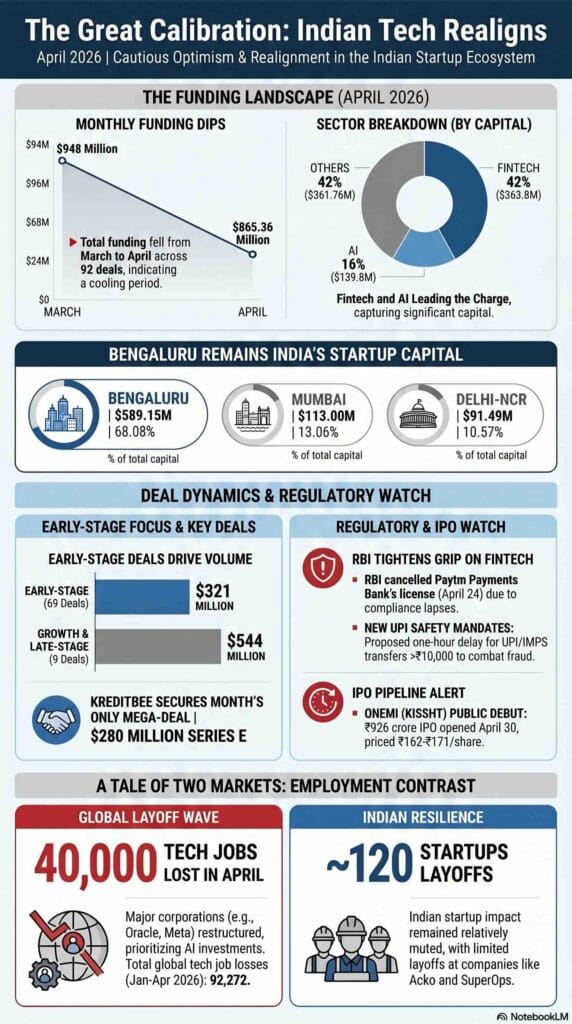
Parallel to these financial shifts, a brutal global workforce restructuring reached a peak in April. Nearly 40,000 tech jobs were lost globally during the month as giants like Oracle, Meta, and Microsoft realigned their priorities toward Artificial Intelligence. Oracle alone laid off 30,000 employees, including over 12,000 in India, via abrupt early-morning notifications.
Interestingly, the domestic startup scene in India saw relatively muted layoffs in April compared to the global big-tech bloodbath, with only about 120 employees impacted at firms like Acko and SuperOps. This suggests that while global firms are cutting to fund AI R&D, Indian startups are currently more focused on operational efficiency and path-to-profitability.
In the manufacturing space, Zelio E-Mobility signaled its growth intentions by appointing Divyanshu Agarwal (formerly of Navi) as its new CEO. The profitable EV manufacturer, which saw a 77% revenue jump in the first half of FY26, is part of a resilient manufacturing and consumer-focused segment that continues to attract capital even as pure-play software funding faces headwinds.
In summary, April 2026 was a month of market calibration. Startups are no longer chasing growth at all costs; instead, they are navigating a disciplined regulatory environment, preparing for the scrutiny of public markets, and grappling with the transformative, and often disruptive, power of AI.
Here is a detailed breakdown of the human impact:
- Abrupt Notifications: At Oracle, which accounted for 30,000 of the layoffs, employees reportedly received abrupt early-morning emails notifying them of their termination as the company shifted priorities toward AI.
- Massive Scale in India: Of the Oracle layoffs, over 12,000 occurred in India alone, highlighting a significant local human cost.
- Major Team Restructuring: Meta reduced its workforce by 10%, impacting approximately 8,000 employees, while Snap cut 16% of its global workforce (about 1,000 people).
- Transition to AI-Driven Operations: The sources describe these layoffs as a visible repercussion of companies “restructuring teams” and “slowing hiring” to prioritize AI investments, automation, and operational efficiency over workforce expansion.
- Voluntary Exits: Beyond direct cuts, Microsoft offered voluntary retirement to 8,750 employees in the US as part of its restructuring.

