

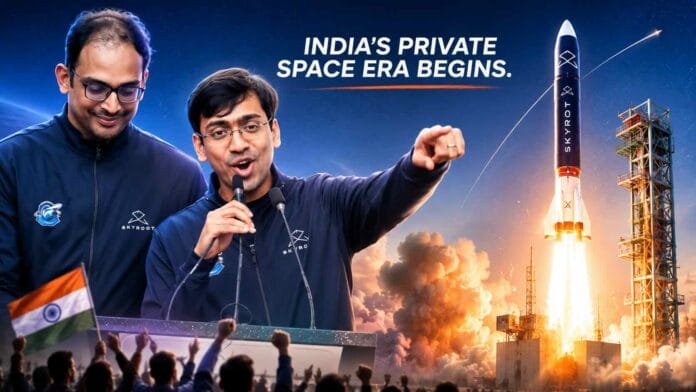
July 18, 2026: Sriharikota: Skyroot Aerospace has achieved what many considered the defining milestone for India’s private space industry. Its Vikram-1 launch vehicle has successfully reached orbit, becoming the first privately developed Indian rocket to complete an orbital mission.
The achievement is historic for the Hyderabad-based startup, but its significance extends far beyond one successful launch. It marks the moment India’s space ambitions moved beyond being driven almost exclusively by government missions to becoming a commercial opportunity led by private enterprise.
For decades, ISRO established India as one of the world’s most reliable and cost-effective space agencies. However, the next phase of growth was always expected to come from startups capable of building launch vehicles, satellites, propulsion systems and space infrastructure for commercial customers. Vikram-1 demonstrates that Indian private companies are now capable of executing missions that were once the exclusive domain of national space agencies.
The mission, aptly named Aagaman, represents more than a technological breakthrough. It validates years of policy reforms that opened India’s space sector to private participation, enabling startups to access ISRO’s infrastructure, collaborate with government agencies and compete in the global launch market.
Skyroot’s Vikram-1 Is More Than a Rocket, It’s India’s New Space Economy
The global space economy is projected to grow rapidly over the next decade, fuelled by demand for satellite communications, Earth observation, navigation, defence applications and emerging in-space services. Every one of these markets depends on reliable and affordable launch providers.
That creates a significant opportunity for Indian companies.
Until now, India’s competitive advantage has largely been associated with low-cost engineering and ISRO’s launch capabilities. A successful orbital mission by a private startup expands that proposition. It signals that India can build an ecosystem where commercial launch companies compete globally while serving domestic demand.
For investors, it is another indication that deep-tech startups in India are maturing beyond software into sectors requiring advanced engineering, long development cycles and substantial capital investment.
Skyroot’s Historic Launch Signals India’s Commercial Space Future
While Vikram-1‘s success is a landmark achievement, it is only the beginning of a much longer journey.
The global launch industry rewards consistency more than individual milestones. Customers will now look for launch cadence, reliability, payload flexibility, turnaround time and competitive pricing before committing long-term business.
For Skyroot, the next challenge is evolving from demonstrating technological capability to building a commercially scalable launch business.
For India’s broader space ecosystem, the opportunity is even larger. As more private launch providers, satellite manufacturers and downstream space-tech companies emerge, India could evolve into a full-service commercial space hub rather than simply a launch destination.
Vikram-1 may eventually be remembered not because it was India’s first privately built rocket to reach orbit, but because it proved that India’s private space industry is ready to compete on the global stage.
The next decade will not be defined by whether Indian startups can build rockets. It will be defined by whether they can build sustainable businesses around them. If that happens, Vikram-1 will be seen as the launch that transformed India’s space programme into a globally competitive space economy.
Alongside its technological milestone, Vikram-1 carried a deeply symbolic payload that reflected the aspirations behind India’s first private orbital mission. Among the items onboard was a special commemorative card bearing a handwritten message from Prime Minister Narendra Modi. In a simple yet powerful tribute to the mission, the Prime Minister wrote, “Vande Mataram,” a message that journeyed beyond Earth’s atmosphere alongside the rocket.
The Prime Minister’s note was one of hundreds of commemorative postcards flown aboard the mission, each carrying messages, wishes and aspirations from people around the world. Together, they transformed the launch into more than a demonstration of engineering excellence, making it a shared celebration of human ambition and exploration.
Skyroot Aerospace also honoured the people behind the mission in a unique way. Ahead of Mission Aagaman, the company revealed that Vikram-1 carried the signatures of the engineers, technicians and every team member who contributed to designing, building, testing and launching the rocket. The gesture ensured that the individuals whose dedication made India’s first private orbital mission possible became a permanent part of its historic journey into space.

