

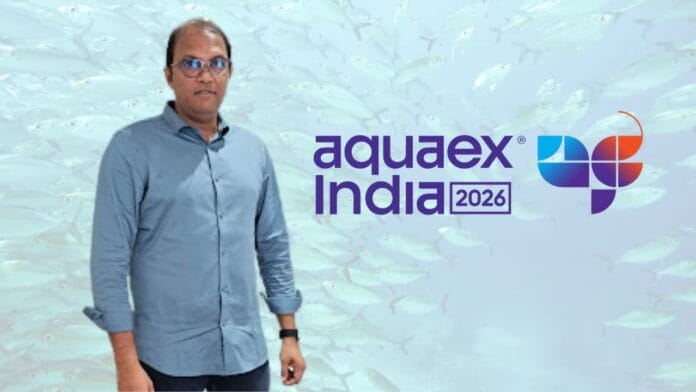
Wednesday, June 3, 2026: There are people who build businesses, and then there are people who quietly reshape how an entire industry learns to see itself.
Venu Dantuluri belongs to the second category, not because he set out to, but because he never quite stopped asking a question most others learned to accept.
It began in childhood, in the waterlogged rhythms of coastal Andhra Pradesh, in and around Bhimavaram, a place where fishponds are as common as front yards. He would watch farmers work with precision that bordered on ritual: early mornings, careful feeding, constant vigilance over water quality, cycles of risk that repeated with seasonal certainty. And yet, even as effort remained constant, outcomes did not.
Why do some farmers do well while others struggle so much?
More pointedly: why is the farmer who works the hardest often the one who earns the least?
The questions didn’t announce themselves as ambition. They lingered as discomfort.
Years later, that discomfort would become design.
Venu’s early exposure to agriculture and aquaculture wasn’t observational, it was inherited. His family was already inside the system. The work he later took up supplying feed, medicines, and equipment to farmers was not glamorous by any measure. But it gave him something rarer than strategy: proximity.
“When you are sitting with a farmer every day, really listening to them, you start to understand things you just cannot learn anywhere else,” he says. “What’s working. What’s not. And what’s completely broken.”
What he saw, over and over, was not failure of effort, but failure of connection.
Farmers on one side. Buyers on another. Scientists producing research that rarely reached the field. Government schemes existing in principle more than practice. Technology advancing in pockets, without adoption at scale. A system full of intelligence, but missing circulation.
It is easy to describe that as inefficiency. Venu saw it differently: as fragmentation with human consequences.
His first attempt to address it was digital. AquaApp aimed to stitch together actors across the value chain, to make information flow more freely. It was a useful experiment, he says now, one that clarified something important. The problem was not only informational. It was relational.
The industry didn’t just need a platform. It needed a place.
That realization became AquaEx India.
Venu Dantuluri: The Man Rewiring Indian Aquaculture From Within
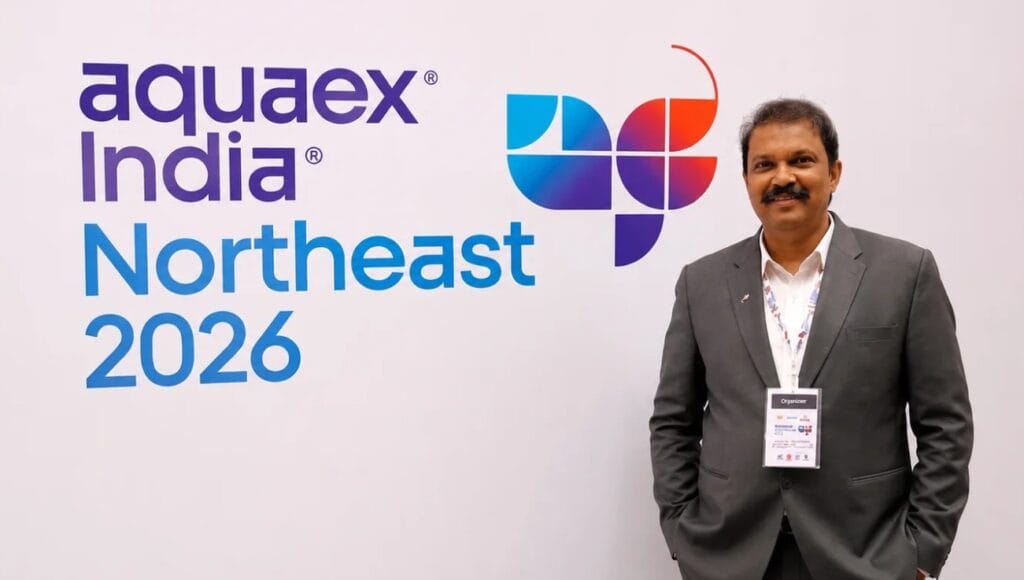
In 2017, AquaEx India took shape. A year later, in 2018, the first large-scale gathering was held at HITEX Exhibition Centre, Hyderabad, bringing together participants from sixteen countries. For an industry that had long operated in silos, geographic, technical, commercial, the scale of convergence was unusual.
Venu remembers the atmosphere less as an event and more as an alignment. Farmers speaking directly with exporters. Scientists listening to traders. Technology providers encountering the practical constraints of the pond, not the lab. The entire chain, in one room, speaking in overlapping truths.
It was not a celebration of aquaculture. It was an exposure of its complexity.
From there, AquaEx began to move, not just geographically, but structurally. It returned to its roots in Bhimavaram, the “spiritual home” of India’s aquaculture economy. It expanded into northern inland fisheries markets in cities like Lucknow, where the industry looked different but the disconnect felt familiar.
Each edition brought a different truth into focus: that aquaculture in India was not one ecosystem, but many ecosystems speaking different languages.
Over time, the platform became something larger than an exhibition. It became a recurring meeting point for an industry learning to see itself as a system.
Today, AquaEx India’s ecosystem facilitates thousands of crores in business annually and has engaged hundreds of thousands of stakeholders through exhibitions, technical forums, and policy dialogues. But Venu tends to resist describing it in purely numerical terms. The more interesting shift, for him, is not scale, it is participation.
Who is in the room now, who wasn’t before. And who is finally being heard.
The next chapter opens in the Northeast.
On 12–13 June 2026, AquaEx Northeast will be hosted at the Maniram Dewan Trade Centre. For Venu, it is expansion, but not just expansion for its own sake. It is a correction of attention.
The Northeast, with its rivers, wetlands, and long-standing fishing communities, holds significant aquaculture potential. Yet, as Venu puts it quietly, it has not received proportionate focus from industry ecosystems. The goal now is to connect these regions more directly to markets, technology, investment, and policy networks that have historically remained distant.
What is being built is no longer just an event series. It is evolving into a distributed infrastructure, training programs, skill development initiatives, farmer marketplaces, and contract farming linkages embedded into state-level partnerships.
Venu calls it, with deliberate understatement, “something that has roots, not just footprint.”
By 2028, the ambition is for AquaEx to exist across every major aquaculture state in India, not as a calendar of exhibitions, but as a living network of relationships and systems.
Still, when asked what success looks like, Venu’s answer does not expand. It simplifies.
He wants everyone in the industry to win.
The farmer. The processor. The trader. The exporter. The entrepreneur just starting out.
“A genuine win-win for everybody,” he says. “That’s the hope.”
It is an idea that sounds almost disarmingly uncomplicated until one considers how rarely systems are designed that way, and how often they drift in the opposite direction.
What makes Venu’s work distinctive is not that he has solved that contradiction. It is that he continues to sit inside it, building anyway, learning anyway, adjusting course without abandoning the premise.
“We don’t claim to have all the answers,” he says. “We are learning every single day. But we genuinely believe the best days for Indian aquaculture are still very much ahead of us.”
From Bhimavaram’s ponds to the river systems of the Northeast, that belief travels quietly. Not as a slogan, but as method.

