

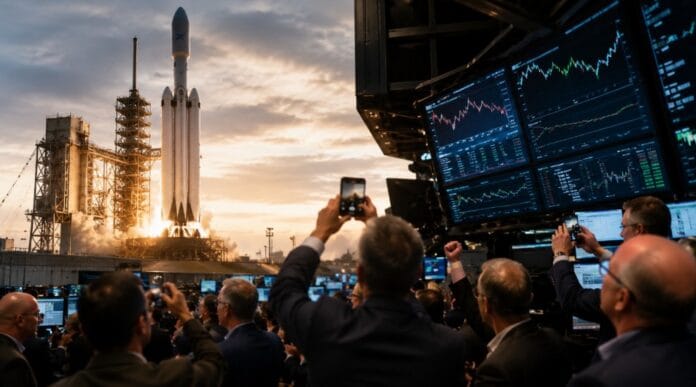
Friday, June 12, 2026: SpaceX has entered public markets with a historic statement of intent.
The aerospace and satellite communications giant has reportedly raised $75 billion in what is being described as the largest initial public offering in history, debuting at a staggering $1.77 trillion valuation. The milestone eclipses previous IPO records and places the company among the world’s most valuable corporations despite reporting losses in recent years.
The listing marks a defining moment not only for SpaceX but for global capital markets. Investors are effectively placing a multi-trillion-dollar bet on the future of commercial space, satellite connectivity, reusable launch systems, and potentially artificial intelligence.
Unlike traditional public offerings that are anchored largely to current earnings and cash flows, SpaceX’s valuation reflects expectations of what the company could become over the next decade.
SpaceX Delivers A Market Pricing the Future
For years, SpaceX has transformed the economics of space launches through reusable rockets, securing a dominant position in both commercial and government launch contracts. At the same time, its Starlink satellite network has evolved into a rapidly expanding global broadband platform serving millions of users across multiple continents.
Investors appear to be viewing these businesses not as standalone operations but as interconnected pillars of a future technology ecosystem.
The market’s thesis is straightforward: if SpaceX continues to lower launch costs, expand Starlink’s reach, and successfully commercialize new ventures, it could become one of the most influential infrastructure companies of the 21st century.
The valuation also reflects growing speculation that SpaceX’s broader ecosystem could benefit from advances in artificial intelligence through Elon Musk’s AI company, xAI, creating additional long-term growth opportunities.
However, the premium being assigned to that future is enormous.
Profits Take a Back Seat
One of the most striking aspects of the IPO is the disconnect between current financial performance and market value.
Historically, companies reaching trillion-dollar valuations have generated substantial profits and demonstrated predictable cash-flow generation. SpaceX’s valuation, by contrast, is being driven largely by anticipated future market creation rather than existing profitability.
This reflects a broader shift in investor behavior, particularly in sectors where technological breakthroughs have the potential to create entirely new industries.
Investors are not buying a mature aerospace company. They are buying exposure to the possibility that SpaceX becomes the dominant infrastructure layer for space transportation, satellite internet, and future off-Earth economic activity.
That distinction is critical.
The company’s supporters argue that traditional valuation models struggle to account for businesses that are building markets that barely exist today. Critics, meanwhile, contend that such valuations can create expectations that become increasingly difficult to meet.
Ripple Effects Across Capital Markets : SpaceX’s IPO Tests the Limits of Investor Optimism
The implications of SpaceX’s debut extend well beyond the company itself.
The listing is likely to become a benchmark for future technology IPOs, particularly those operating in artificial intelligence, robotics, advanced manufacturing, and deep-tech sectors.
Investment banks, venture capital firms, and institutional investors will closely monitor the stock’s performance in the months ahead. A successful post-listing trajectory could reignite enthusiasm for large-scale technology offerings that have remained on the sidelines amid market uncertainty.
Conversely, significant volatility could raise questions about how far investors are willing to stretch valuations in pursuit of future growth.
Several high-profile private companies, including leading AI developers and next-generation infrastructure startups, are expected to study the outcome closely as they evaluate their own public-market ambitions.
A Defining Test for Growth Investing
SpaceX’s IPO arrives at a time when markets are increasingly rewarding companies that promise transformative outcomes rather than incremental improvements.
The company sits at the intersection of multiple high-growth themes: space commercialization, satellite communications, artificial intelligence, advanced manufacturing, and global connectivity.
That combination makes it one of the most ambitious investment stories in modern market history.
Yet ambition alone does not guarantee success.
At a $1.77 trillion valuation, execution risk becomes magnified. Investors will be looking for sustained revenue growth, improved profitability, expansion of Starlink services, successful deployment of next-generation launch systems, and evidence that the company’s long-term vision can translate into durable shareholder value.
Analysis: The Ultimate Vision Premium
SpaceX’s IPO may ultimately be remembered as a defining moment in the evolution of modern capital markets.
The valuation reflects something larger than financial metrics. It represents investor belief in the power of technological disruption and the willingness of markets to fund companies pursuing extraordinarily ambitious goals.
Whether the valuation proves justified will depend on SpaceX’s ability to execute at a scale rarely seen in corporate history.
For now, investors are paying for possibility rather than certainty.
The company has convinced markets that the future it is building could be significantly larger than the industries that exist today. The question is no longer whether SpaceX can innovate. It is whether innovation can keep pace with expectations worth nearly two trillion dollars.
As markets digest the implications of this landmark listing, one thing is clear: the SpaceX IPO has redefined the conversation around growth, valuation, and the limits of investor optimism.

