

August 4, 2026: Bengaluru, Chennai, Noida emerge as major hubs as companies invest in workforce infrastructure, skilling and retention
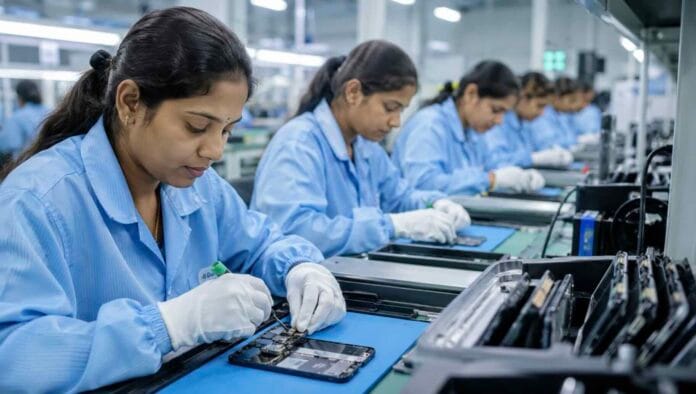
India’s electronics manufacturing expansion is creating a new workforce narrative, with women becoming a significant force across assembly lines, production facilities and emerging technical roles.
Driven by investments under the Production Linked Incentive (PLI) scheme and rising global interest in India as a manufacturing destination, companies are scaling operations while building employment models that bring thousands of women into formal industrial jobs.
The scale of this shift is visible across major manufacturing clusters.
At Foxconn’s Bengaluru facility, around 21,780 women form a majority of the company’s 26,000-strong workforce, including nearly 16,500 contract employees. The company has also invested in women-focused residential facilities with capacity for 30,000 employees, highlighting how worker accommodation, mobility and safety have become critical components of manufacturing expansion.
Foxconn’s Tamil Nadu operations employ around 41,000 people, making it one of the largest electronics manufacturing employers in the country.
Karnataka emerges as a manufacturing employment hub
Karnataka has become one of India’s leading electronics manufacturing centres, supported by Bengaluru’s deep technology ecosystem and growing industrial base.
The state has 19,177 registered industries employing nearly 1.9 million workers. Bengaluru Urban alone accounts for 8,429 industries and more than 8.3 lakh workers, while Bengaluru Rural contributes another 1.6 lakh jobs.
Women currently represent around 5.9 lakh workers, or 30.4% of Karnataka’s industrial workforce.
Industry leaders point to a combination of factors behind this growth, including improved workplace infrastructure, better transport connectivity, women-friendly policies and regulatory changes enabling women to work across shifts with appropriate safety measures.
Noida-Greater Noida builds a women-led electronics workforce
A similar transformation is underway in Uttar Pradesh’s Noida-Greater Noida manufacturing corridor.
The region has emerged as a major electronics production centre, with companies including Samsung, Dixon Technologies, Lava International and Optiemus expanding manufacturing operations and apprenticeship programmes.
The Noida-Ghaziabad electronics cluster now employs an estimated 80,000 women, largely across mobile phone and electronics assembly roles.
Across Uttar Pradesh, women account for an estimated 22-25% of organised manufacturing employment, with participation concentrated in electronics, garments, footwear and food processing.
Companies are increasingly investing in transport, hostels, training programmes and structured career pathways to build a stable workforce pipeline.
Tamil Nadu strengthens its position as India’s electronics powerhouse
Tamil Nadu continues to lead India’s electronics manufacturing sector, accounting for 285 factories and around 1.2 lakh workers, representing 25.2% of India’s electronics factory workforce.
Women account for around 40.8% of direct electronics employment in the state.
The Kancheepuram and Krishnagiri regions have emerged as key manufacturing clusters, attracting investments from global and domestic companies.
Foxconn’s iPhone manufacturing operations near Chennai employ around 41,000 people, including approximately 35,000 women.
Tata Electronics’ Hosur facility employs around 75,000 people, with women making up 70-80% of its workforce.
Other major employers in Tamil Nadu include Salcomp, Flex, Corning, Jabil India and Kaynes Technology.
Automation changes the nature of factory jobs
The rise of automation is also reshaping opportunities for women in manufacturing.
At Delta Electronics’ Krishnagiri facility, women account for 66% of its 3,925 employees. Across Delta India, women’s representation has increased from 2% to 48% in six years.
Companies say modern electronics manufacturing increasingly depends on precision, process discipline and quality control rather than physical strength.
As automation reduces manual handling requirements, more women are moving beyond operator roles into technician, supervisor and line leadership positions.
Manufacturers are redesigning shop floors, introducing ergonomic solutions and creating work environments that support longer-term participation.
Electronics manufacturing becomes a major source of women’s employment
Electronics has emerged as one of India’s strongest job creators for women.
According to industry estimates, women account for nearly 30% of the 25 lakh jobs created in electronics manufacturing over the past decade.
In mobile phone manufacturing specifically, women represent nearly 70% of the 12 lakh direct jobs created in the sector.
The PLI scheme alone has contributed close to 90,000 jobs for women, reinforcing electronics manufacturing’s role as a pathway into formal employment.
The next challenge: building careers, not just jobs
While hiring numbers are growing rapidly, companies increasingly recognise that retention will determine the long-term impact of this workforce transformation.
Quess Corp estimates India’s manufacturing sector employs around 7.5-8 crore people, while women account for nearly 74.5% of the electronics manufacturing services workforce, significantly higher than the overall manufacturing average.
However, workforce participation depends on more than employment opportunities.
Companies are focusing on workplace safety, affordable housing, transportation, childcare support, skill development and career progression to improve retention.
The next stage of India’s electronics manufacturing journey will depend on converting large-scale hiring into sustainable career pathways.
As global companies diversify supply chains and India strengthens its manufacturing capabilities, the ability to build an inclusive, skilled and stable workforce could become one of the country’s biggest competitive advantages.

