

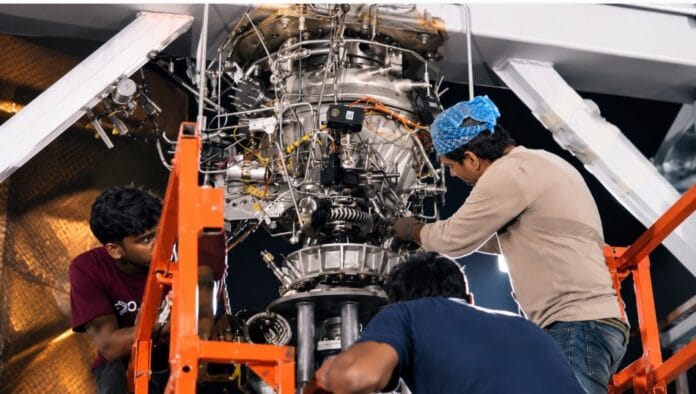
Bengaluru, August 8: Bengaluru based space technology startup Astrobase Space Technologies has unveiled what it describes as India’s first privately built full flow staged combustion, or FFSC, liquid oxygen and methane rocket engine, marking an ambitious step in the country’s growing private launch industry.
Named EVEREST, the engine is designed to produce 800 kilonewtons of thrust and is intended for reusable medium lift launch vehicles.
The FFSC architecture is among the most advanced rocket engine configurations, with both fuel and oxidiser passing through preburners before entering the main combustion chamber. The architecture is designed to extract a high level of performance from the propellant while supporting efficient engine operation.
For Astrobase, however, the engine launch is part of a larger industrial ambition.
The company plans to establish manufacturing infrastructure capable of producing up to 50 EVEREST engines a year. Its first phase targets approximately 100 tonnes of annual launch capacity, which the company says could support a Low Earth Orbit fleet of around 500 to 700 satellites.
A second phase is planned to take that capacity beyond 1,000 tonnes annually.
The scale of the ambition reflects a changing Indian space market, where satellite operators, launch providers and emerging space companies are creating demand for propulsion systems that can be produced domestically and at higher volumes.
𝗧𝗵𝗲 𝗘𝗻𝗴𝗶𝗻𝗲 𝗜𝘀 𝗨𝗻𝘃𝗲𝗶𝗹𝗲𝗱. 𝗡𝗼𝘄 𝗖𝗼𝗺𝗲𝘀 𝗧𝗵𝗲 𝗥𝗲𝗮𝗹 𝗧𝗲𝘀𝘁 𝗙𝗼𝗿 𝗔𝘀𝘁𝗿𝗼𝗯𝗮𝘀𝗲
Neeraj Khandelwal, co founder and CEO of Astrobase Space Technologies, said EVEREST represents the foundation of an industrial capability that India will increasingly need.
“With tens of thousands of satellites expected to be deployed over the coming decade, indigenous high thrust propulsion systems and scalable launch infrastructure will be critical to strengthening India’s position in the global space economy,” Khandelwal said.
The immediate milestone, however, comes with an important qualification. EVEREST has yet to undergo testing, and the company has yet to finalise its testing timeline.
That makes the announcement an engineering and development milestone rather than a demonstrated flight capability.
For Astrobase, the next challenge will therefore be moving from an unveiled engine to a tested and repeatable propulsion system, followed by manufacturing at the volumes the company has outlined.
That transition is often where ambitious space ventures face their toughest test. Designing an advanced engine is one challenge. Proving reliability, establishing production processes and eventually integrating the engine into a launch vehicle represent a much larger industrial task.
Astrobase is now positioning itself for that next stage.
If it can move EVEREST successfully through testing, qualification and production, the significance could extend beyond a single engine programme. It could add another privately developed propulsion capability to India’s expanding space ecosystem and strengthen the country’s ambitions in commercial launch services.
For now, the headline is the engine.
The bigger story will be whether Astrobase can turn 800 kilonewtons of promised thrust into a reliable, repeatable and commercially viable launch capability.

